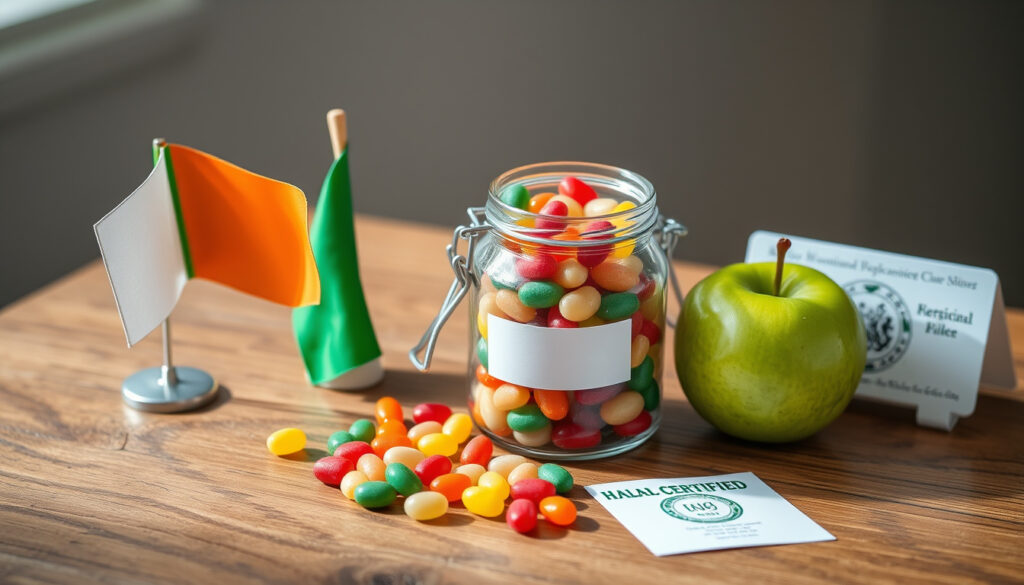
Jelly Beans: Health, History, Irish Stockists & Halal Guide
Few sweets spark as much curiosity as jelly beans — they show up in Easter baskets, on nurses’ trays, and even in medical labs. A guide to the nutrition facts, health trade-offs, and where to find them in Ireland, whether you follow halal or gluten-free diets.
Year jelly beans first appeared: 1861 ·
Number of flavors by Jelly Belly: 100+ ·
Calories per 35g serving: 140 ·
Sugar content per serving (grams): 28 ·
Countries where Jelly Belly is sold: 60+ ·
Top-selling flavor in the US: Very Cherry
Quick snapshot
- First produced in the US in 1861 (Wikipedia)
- Jelly Belly offers 100+ flavors (Jelly Belly)
- The Jelly Bean Factory in Ireland makes halal, gluten-free beans (The Jelly Bean Factory)
- Used as an alternative to 50g glucose drink in tolerance tests (PubMed)
- Exact reason for temporary store shortages — likely supply chain but unconfirmed
- Halal certification varies by brand and batch; always check packaging
- Long-term health effects of moderate consumption vs other sweets not well studied
- Halal certification status of Jelly Belly varies by batch and market
- 1861 – First jelly beans produced in the US (Wikipedia)
- 1976 – Jelly Belly founded in California (Jelly Belly)
- 1990s – The Jelly Bean Factory established in Ireland (Cloetta UK)
- 2000s – Clinical studies validate glucose alternative use (PubMed)
- 2020s – Supply disruptions affect in-store availability (Wikipedia)
- Increased demand for certified halal and gluten-free options
- More brands entering the market with transparent labeling
- Online availability remains steady while retail restocks lag
Six facts tell the story of this tiny bean in a nutshell.
| Fact | Value |
|---|---|
| First documented production | 1861 (United States) |
| Average number of calories per 35g | 140 |
| Manufacturing countries | USA, Ireland, UK, Canada |
| Jelly Belly flavor count | 100+ |
| Ireland-based brand | The Jelly Bean Factory |
| Clinical use | Alternative to 50g glucose beverage in glucose tolerance tests |
Are Jelly Beans Good or Bad for You?
Nutritional profile of jelly beans
- Per 100g, jelly beans contain about 375 calories, 94g carbohydrates, and 70g sugar, with virtually no protein or fiber (FoodStruct).
- A standard 35g serving (about 30 beans) delivers 140 calories and 28g sugar.
- They have a glycemic index of 80, meaning they cause a rapid spike in blood sugar (FoodStruct).
Potential health benefits
The main upside is quick energy. Doctors sometimes use jelly beans as a glucose alternative for hypoglycemia or during glucose tolerance tests — a 2015 study found that whole jelly beans were equivalent to a 50g glucose drink (PubMed). That’s a narrow benefit, but real.
Risks of overconsumption
- High sugar intake is linked to weight gain, tooth decay, and metabolic issues.
- With no fiber, protein, or fat, jelly beans offer empty calories that spike then crash energy.
- Moderation is the key — occasional handful, not daily habit.
Jelly beans are a rare candy that can serve as a medical tool, but for daily snacking they are pure sugar with no nutritional upside. The clinical use does not make them healthy — it makes them a precise glucose delivery system.
The trade-off between medical utility and nutritional emptiness defines the jelly bean’s unique position in the candy world.
Why Can’t I Find Jelly Beans Anymore?
Temporary supply chain issues
- Jelly bean production is often seasonal, with peak runs before Easter and holidays.
- Global supply chain disruptions in the 2020s have caused sporadic shortages in some regions (Jelly Belly notes ongoing supply chain management).
- Retailer stock varies by region and is not always consistent.
Local stockist search tips
- In Ireland, Tesco Ireland stocks Jelly Beans Sweets 200g bags.
- Lidl brings in jelly beans seasonally.
- Specialist shops like Candyland Galway and Sweet Boutique Ireland carry Jelly Belly and The Jelly Bean Factory year-round.
The local availability issue is patchy, but online options remain reliable for those who need a specific dietary profile.
What Country Is Jellybean From?
Origins of jelly beans
Jelly beans first appeared in the United States in 1861, likely inspired by Turkish Delight (Wikipedia). They were advertised as a penny candy and became a Easter staple by the 1930s.
Major manufacturers
- Jelly Belly: Founded in California in 1976, now produces over 100 flavors (Jelly Belly).
- The Jelly Bean Factory: Based in Ireland, claims to be the UK’s number 1 gourmet jelly bean brand (Cloetta UK).
- Global production also occurs in the UK, Canada, and Australia.
The jelly bean’s origin story is distinctly American, but its production has become global, with Ireland playing a notable role through The Jelly Bean Factory.
Why Do Doctors Give Jelly Beans?
Jelly beans in glucose tolerance tests
A 2015 clinical study published in Diabetes Care tested whole jelly beans as an alternative to the standard 50g glucose beverage for gestational diabetes screening (PubMed). The result: jelly beans were non-inferior and better tolerated by patients who found the drink too sweet.
Clinical applications
- Used for diabetic patients with hypoglycemia to raise blood sugar quickly.
- Preferred by some clinics because they are portable, shelf-stable, and have a predictable carbohydrate content.
“Whole jelly beans are a safe and acceptable alternative to the standard 50-g glucose beverage for gestational diabetes screening.”
— Clinical study, Diabetes Care, 2015
For pregnant women in Ireland who struggle with the glucose drink, knowing that jelly beans are a validated option can make screening less unpleasant. But it’s a specific medical use — not a free pass to eat them by the handful.
The clinical use validates jelly beans as a precision glucose tool, but it does not extend to general snacking.
What Is the Jelly Bean Rule?
Origin of the term
The “jelly bean rule” comes from a former Google internal policy. It stated that developers should be treated like jelly beans — you judge them by their output, not by their identity or background (Wikipedia). The analogy: you don’t care which factory made a jelly bean, only that it tastes good.
Application in software development
- Used to promote meritocracy and reduce bias in code reviews.
- Critics argue the rule oversimplifies team dynamics and ignores the value of diversity.
The rule’s application in tech culture highlights an interesting metaphor, though its critics point out the oversimplification of identity in workplace dynamics.
What Sweets Are Muslims Allowed to Eat?
Halal certification criteria
For a sweet to be halal, it must contain no pork-derived ingredients (especially gelatin) and no alcohol. Many standard jelly beans use pork gelatin, making them non-halal. However, several brands now produce halal-certified versions.
Brands offering halal jelly beans
- The Jelly Bean Factory states all its products are halal compliant (The Jelly Bean Factory).
- Simply Wize (Australia) markets its jelly beans as halal certified (Simply Wize).
- Jelly Belly uses beeswax and confectioners glaze for shine, and does not contain meat, gelatin, dairy, or eggs — but its halal certification status varies by market (Mustakshif Halal Scanner).
- Always check for a halal logo on the packaging, as individual batches may differ.
“Many jelly beans contain pork gelatin and are not halal. Some brands produce halal-certified versions. Always check packaging for halal logo.”
— Halal certification guidance (HalalCodeCheck)
Are Jelly Beans Healthy?
Comparison with other sweets
- Jelly beans have similar sugar content to gummy bears and marshmallows but less fat.
- They contain no vitamins, minerals, or fiber — unlike chocolate which offers some antioxidants and minerals.
- They are less calorie-dense than nuts or chocolate bars, but offer zero satiety.
Portion control advice
- A 35g serving (about 30 beans) = 140 calories. That’s fine as an occasional treat.
- Eating from a large bag mindlessly can lead to 300+ calories in one sitting.
- Buying pre-portioned bags or small tubs helps control intake.
Healthier alternatives
- Fresh fruit provides natural sugar with fiber and vitamins.
- Dark chocolate (70%+ cocoa) offers antioxidants and lower sugar per gram.
- For a chewy fix, try dried fruit or yogurt-coated raisins.
Ultimately, jelly beans are a treat, not a staple, and moderation is the key to incorporating them without compromising health goals.
Upsides
- Quick energy source for hypoglycemia or exercise
- Widely available in many flavors and formats
- Many brands are gelatin-free and some are halal/gluten-free
- Portable and shelf-stable
Downsides
- High sugar content (70g per 100g) with no fiber
- Glycemic index of 80 — rapid blood sugar spike
- No protein, fat, or micronutrients
- Pork gelatin in many standard brands — not halal/vegan
Summary
Jelly beans occupy a rare space where candy meets clinical use. They can save a diabetic from a low-blood-sugar episode or ruin a healthy diet if eaten without restraint. For the Irish shopper with dietary restrictions, the choice is clear: buy from The Jelly Bean Factory or Simply Wize for halal/gluten-free assurance, buy Jelly Belly for flavor variety (but verify halal per batch), or skip altogether and reach for fruit. The trade-off is between convenience and nutrition — and the bean itself won’t make that decision for you.
the-jelly-bean-factory.de, the-jelly-bean-factory.de, reddit.com, facebook.com, sweetboutique.ie
For a deeper look at how jelly bean as a cultural term has evolved beyond candy, the article explores its use as slang and its connection to an Instagram star.
Frequently asked questions
What are the main ingredients in jelly beans?
Sugar, corn syrup, modified food starch, natural and artificial flavors, and coloring. Some brands use beeswax or confectioners glaze for shine. Always check the label for specific additives.
Are jelly beans suitable for diabetics?
They have a glycemic index of 80, so they raise blood sugar quickly. Diabetics should only eat them under medical advice, e.g., to treat hypoglycemia. They are not a recommended snack for daily management.
Do jelly beans contain any allergens?
Standard jelly beans are often free of the top allergens (milk, eggs, peanuts, tree nuts, soy, wheat), but cross-contamination is possible. The Jelly Bean Factory states its products are nut-free and gluten-free.
How many jelly beans are in a standard 200g bag?
Approximately 170–200 beans, depending on size. A typical single jelly bean weighs about 1–1.2 grams.
What is the shelf life of jelly beans?
Unopened, 12–18 months from production date. Once opened, store in a cool, dry place and consume within a few months for best texture. They can harden if exposed to air.
Are there sugar-free jelly beans available?
Yes, some brands offer sugar-free versions using artificial sweeteners like sorbitol or stevia. However, they can cause digestive upset if eaten in large amounts.
Can jelly beans be part of a weight-loss diet?
In very small portions (e.g., 10 beans = 47 calories) they can fit into a calorie-controlled diet, but they offer no satiety. Most dietitians recommend fruit instead for a sweet fix with fiber.
Which Irish stores stock Jelly Belly regularly?
Tesco Ireland stocks Jelly Beans Sweets (own brand). Candyland Galway and Sweet Boutique Ireland carry Jelly Belly. Lidl and Aldi stock seasonal varieties. Online at Yachew and Sweet Boutique for The Jelly Bean Factory range.
Related reading: Air Fryer French Fries: Best Times, Temps & Crispy Tips · Classic Meatloaf Recipe: Basic Ingredients, Secrets, and Tips
More related posts
 Naomi Judd Cause of Death and Family Tragedy
 How Old Is Google in 2025? 27 Years Since 1998 Founding
 1 Bitcoin to USD: Live Price, Pizza Day & Returns
 Canada Postal Workers Strike Update: Latest Vote and Status
 What Happened to Pat Sajak? Health Scare and Retirement
 On Wings of Blood – Summary, Characters, Themes
 Maple Leafs Mitch Marner Contract: Vegas Trade Details
 John Ternus: Apple’s Next CEO – Bio, Net Worth, What to Expect
