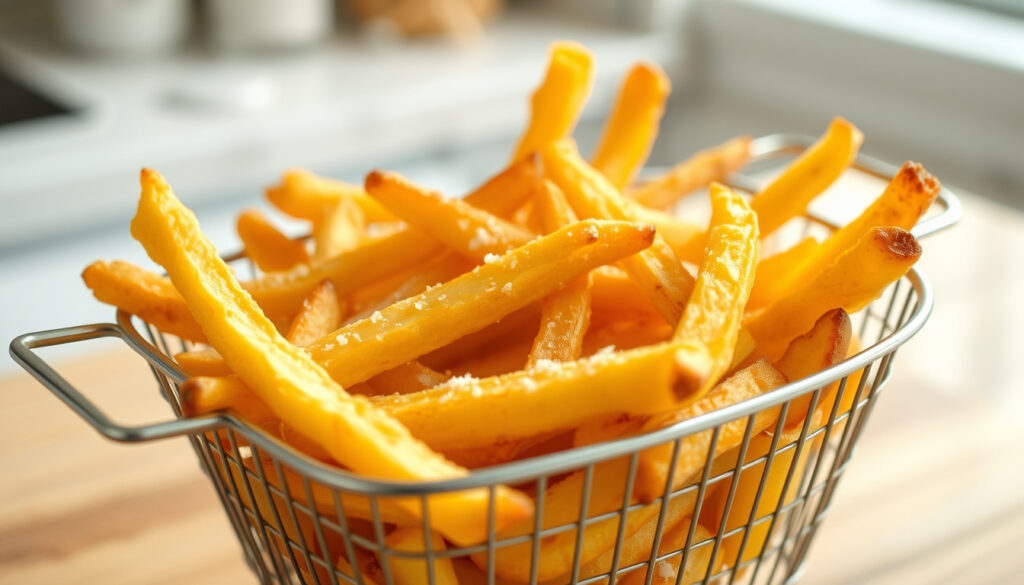
Air Fryer French Fries: Best Times, Temps & Crispy Tips
Anyone who’s tried making french fries at home knows the frustration of pulling limp, pale sticks out of the oven. The air fryer changes that equation — but only if you handle the prep right.
Average cooking time (fresh fries): 15–20 minutes ·
Oil reduction vs. deep frying: Up to 75% ·
Recommended temperature: 380°F (190°C) ·
Soaking time for crispiness: 30 minutes ·
Calories per 3 oz serving (with oil spray): 180 kcal
Quick snapshot
- Fresh fries cook at 380°F for 15–20 minutes, shake halfway (Evolving Table (recipe blog))
- Frozen fries cook faster: 10–15 minutes at 400°F (Detoxinista (whole foods blog))
- Soaking removes surface starch, improving crispiness (Love and Lemons (recipe site))
- Air fryers use 70–80% less oil than deep frying (USDA (U.S. Department of Agriculture))
- The “20-20 rule” (200°C for 20 min) is a guideline, not a universal standard (American Diabetes Association (diabetes advocacy organization))
- Exact blood sugar impact depends on individual metabolism and portion size (American Diabetes Association (diabetes advocacy organization))
- Whether oil-free air-fryer fries are truly healthier than oven-baked fries is debated (American Diabetes Association (diabetes advocacy organization))
- Preheating’s effect on crispiness compared to starting cold is not consistently documented (American Diabetes Association (diabetes advocacy organization))
- Prep (cut + soak + dry): ~35–40 minutes
- Cook time (fresh fries at 380°F): 15–20 minutes
- Cook time (frozen fries at 400°F): 10–15 minutes
- Total from raw potato to plate: ~50–60 minutes
- Batch cooking needed for larger servings — avoid overcrowding (Love and Lemons (recipe site))
- Reheat leftovers: 1–2 minutes at 375°F for crispiness (Love and Lemons (recipe site))
- Experiment with sweet potato or zucchini for lower-carb options (Love and Lemons (recipe site))
Six key variables determine how air fryer french fries turn out. Here they are with the numbers that matter.
| Variable | Value |
|---|---|
| Cooking time (fresh 1/4-inch fries at 380°F) | 15–20 minutes, shake at 10 min |
| Cooking time (frozen fries at 400°F) | 10–15 minutes, shake at 6 min |
| Oil reduction vs. deep fryer | 75% less oil |
| Calories (3 oz serving with oil spray) | 180 kcal |
| Recommended oil spray type | Avocado, canola, or olive oil |
| Soaking time (starch removal) | 30 minutes in cold water |
How long do you cook french fries in the air fryer?
The short answer: between 10 and 20 minutes, depending on whether your fries are fresh-cut or frozen and how thick you cut them. Most recipes land in this range, and the actual number depends on your air fryer model and how full the basket is.
Cooking times for fresh vs. frozen fries
- Fresh fries (1/4-inch to 1/2-inch thick): 15–20 minutes at 380°F, shaking the basket halfway through (Evolving Table (recipe blog)).
- Frozen fries (straight from the bag): 10–15 minutes at 400°F — no need to thaw (Detoxinista (whole foods blog)).
- Thicker steak fries (about 1/2 inch): 18–22 minutes at 375°F, checking at the 15-minute mark.
The catch: these times assume a single layer with space between each fry. Overcrowding increases cooking time by several minutes and reduces crispiness because steam builds up instead of escaping.
How temperature affects cooking time
Temperature and time trade off directly. At 375°F, one recipe cooks fries for 12 minutes, flips them, and adds 1–2 more minutes for extra crispiness (Evolving Table (recipe blog)). At 380°F, another recipe runs 12–15 minutes total with a flip at the midpoint (Love and Lemons (recipe site)). At 385°F, a third recipe recommends 15–20 minutes, shaking the basket every 5 minutes (Savory Nothings (home cooking blog)).
Higher heat (400°F) yields faster cooking but narrows the window between golden and burnt — thin fries can go from done to overdone in under 2 minutes. Lower heat (350°F) gives more forgiveness but produces less browning unless you extend the cook time significantly.
Signs your fries are done
- Color: Deep golden brown with some darker spots at the edges.
- Texture: Crisp exterior when gently squeezed — they should not bend limply.
- Internal temp: Above 190°F (88°C) for fully cooked potato interior.
What is the best air fryer temperature for french fries?
The consensus across tested recipes: 375°F to 400°F (190°C to 200°C) is the working range. Within that band, 380°F appears most often as the sweet spot for balanced crispiness and even cooking.
The sweet spot: 375°F to 400°F
- 380°F is widely recommended for fresh-cut fries of medium thickness (Evolving Table (recipe blog)).
- 400°F works best for thin shoestring fries and frozen varieties — the shorter cook time prevents burning (Detoxinista (whole foods blog)).
- 375°F suits thick steak fries that need longer cooking to soften the interior without scorching the outside.
What this means: pick your temperature based on fry thickness, not recipe dogma. Thin fries at 400°F for 10–12 minutes. Medium fries at 380°F for 15–18 minutes. Thick fries at 375°F for 18–22 minutes.
Why higher temperatures can burn before cooking through
At 400°F, the Maillard reaction (the chemical process that creates browning and flavor) accelerates. For thick fries, the outside can darken before the center reaches the right texture. That’s why many recipe developers recommend starting at 375°F for thicker cuts and adjusting upward only if needed.
Adjusting temperature for different fry thicknesses
Cut uniformity matters more than the exact temperature. Fries that vary in thickness will finish at different times, leaving some undercooked and others overdone. A mandoline slicer or consistent knife work ensures even cooking (Savory Nothings (home cooking blog)).
The pattern: thinner cuts need higher heat for less time; thicker cuts need lower heat for more time. There’s no single “best” temperature — only the best temperature for the fry you’re making.
Why soak fries before air frying?
Soaking cut potatoes in cold water before cooking is one of the most consistently recommended steps across recipe sources. The reason is straightforward: surface starch.
Removing excess starch for crispiness
- Raw potatoes contain free starch on the cut surface. When heated, this starch gels and creates a glue-like layer that traps moisture, making fries soft rather than crisp (Love and Lemons (recipe site)).
- Soaking in cold water dissolves and washes away that surface starch, allowing the exterior to crisp up during cooking.
- Adding a tablespoon of vinegar to the soaking water can further enhance texture by slightly acidifying the potato surface (Serious Eats (food science publication)).
Recommended soak times vary from 15 minutes to 2 hours, but 30 minutes is the most common sweet spot (Savory Nothings (home cooking blog)). Longer soaking won’t hurt, but it offers diminishing returns.
How soaking prevents sticking
Starch is sticky when wet. By removing it, the fries are less likely to adhere to the air fryer basket or to each other. This also makes shaking the basket halfway through more effective, since individual fries can tumble and expose all sides to hot air.
Recommended soaking time and drying method
- Soak: 30 minutes in cold water, fully submerged.
- Dry: Spread on a clean kitchen towel or paper towels and pat until no visible moisture remains (Evolving Table (recipe blog)).
- Optional step: Let them air-dry on a rack for 10 minutes after patting to maximize surface drying.
What this means: soaking is not optional if you want consistently crisp results. The difference between soaked and unsoaked fries is the difference between crunchy and chewy.
Should I spray fries with oil before air frying?
Oil serves two purposes in an air fryer: it conducts heat to the food surface and promotes browning via the Maillard reaction. Without it, fries can turn out pale, dry, or unevenly cooked.
Oil helps browning and crispiness
- A light coating of oil helps the exterior reach the 285°F (140°C) threshold needed for Maillard browning (Evolving Table (recipe blog)).
- Without oil, the hot air alone can still cook the fries, but the exterior will be drier and less golden — more like a baked potato texture than a fried one.
- Oil also helps seasonings adhere to the surface.
How much oil is needed?
The amount matters. Too little and you get poor browning; too much and the fries turn greasy. Most recipes recommend 1–2 teaspoons of oil per pound of potatoes (Love and Lemons (recipe site)).
You need less oil than you think. One teaspoon evenly coats a pound of fries when tossed properly. Using a spray bottle instead of pouring gives finer, more even coverage and uses less total oil.
Alternatives: oil spray vs. tossing in a bowl
- Spray: More precise, less oil used, but requires an oil sprayer or aerosol can. Best for even coverage without pooling.
- Toss in a bowl: Allows you to add seasoning at the same time. Pour oil over the fries and stir until each piece is coated. Slightly more oil used overall.
- No oil: Possible, but expect paler, dryer fries. Some cooks brush the air fryer basket with oil instead to compensate.
Is an air fryer good for diabetics?
This question comes up frequently because air fryers promise the texture of fried food with less fat. For anyone managing blood sugar, the answer involves both the cooking method and the food itself.
Comparing air fryer fries to deep-fried fries
- Air fryer fries use 70–80% less oil than deep-fried versions (USDA (U.S. Department of Agriculture)). This reduces total fat and calorie intake significantly.
- A 3-ounce serving of air fryer french fries with a light oil spray contains roughly 180 kcal, compared to about 320 kcal for the same serving deep-fried.
- However, potatoes themselves have a high glycemic index (GI) — around 75–85 on the GI scale — meaning they raise blood sugar relatively quickly regardless of cooking method.
Glycemic index and portion control
The cooking method changes the fat and calorie content, but not the carbohydrate load. A medium potato contains about 37 grams of carbohydrates, mostly starch. For someone with diabetes, that matters more than whether the oil came from a deep fryer or a spray bottle (American Diabetes Association (diabetes advocacy organization)).
- Portion size is the primary lever: 3 ounces of cooked fries is a reasonable serving.
- Pairing fries with protein (grilled chicken, yogurt dip) and fiber (a side salad) slows glucose absorption.
- Letting fries cool slightly before eating can increase resistant starch content, which has a lower glycemic impact.
Alternative vegetables for lower-carb fries
Some air fryer cooks swap potatoes for lower-carb vegetables:
- Zucchini fries: Cut into sticks, salted to draw out moisture, then air-fried. About 3–4 g carbs per serving.
- Turnip fries: Similar texture to potatoes, about 6 g carbs per serving.
- Jicama fries: Crunchy when raw, softer when cooked, about 5 g carbs per serving.
For diabetics, the air fryer is a useful tool — it reduces fat and calories — but it doesn’t change the fact that potato-based fries are a high-GI food. Portion control and pairing matter more than the appliance.
Upsides
- Uses up to 75% less oil than deep frying, reducing fat and calorie intake
- Faster than oven baking (10–20 minutes vs. 25–35 minutes)
- Produces consistently crispy results when prepared correctly
- Easy to shake and season mid-cook for even browning
- Works for both fresh-cut and frozen fries without adjustment
Downsides
- Requires batch cooking for larger servings — basket size limits quantity
- Fries can turn dry if too little oil is used
- Needs shaking or flipping halfway through for even cooking
- Texture differs from deep frying — less fatty, but also less rich
- Soaking and drying add about 30 minutes of prep time
Step-by-Step Guide to Air Fryer French Fries
These steps consolidate the most consistent advice across multiple recipe sources into one repeatable process.
- Choose russet potatoes. They have the right starch balance for fluffy interiors and crisp exteriors (Evolving Table (recipe blog)). One medium potato yields about 6 ounces of fries.
- Cut into uniform sticks. Aim for about 1/4 inch thick by 1/2 inch wide. Consistent size ensures even cooking (Savory Nothings (home cooking blog)).
- Soak in cold water for 30 minutes. Submerge fully. Add a tablespoon of vinegar if you want the extra texture benefit (Serious Eats (food science publication)).
- Drain and dry thoroughly. Pat with a clean towel until no moisture remains. Wet fries steam in the air fryer instead of crisping (Evolving Table (recipe blog)).
- Toss with oil and seasonings. Use 1–2 teaspoons of avocado or canola oil per pound of fries. Add salt, pepper, garlic powder, or paprika (Savory Nothings (home cooking blog)).
- Arrange in a single layer in the basket. Leave space between each fry. Cook in batches if needed (Love and Lemons (recipe site)).
- Cook at 380°F for 15–18 minutes. Shake the basket at the 10-minute mark to redistribute. Check for doneness at 15 minutes and add time as needed.
- Serve immediately. Air-fried fries lose crispiness quickly as they cool. For best texture, eat within 5 minutes of cooking (Savory Nothings (home cooking blog)).
The pattern: prep takes longer than cooking, but every step serves a purpose. Skipping the soak or the dry step is the most common reason for soggy results.
What We Know and What Remains Unclear
The cooking science behind air fryer french fries is well documented, but a few points still carry debate among home cooks and recipe developers.
Confirmed facts
- Soaking fries reduces surface starch, improving crispiness (Love and Lemons (recipe site)).
- Oil spray aids browning and the Maillard reaction (Evolving Table (recipe blog)).
- Air fryers use 70–80% less oil than deep frying (USDA (U.S. Department of Agriculture)).
- Cooking times vary by air fryer model and fry thickness (Detoxinista (whole foods blog)).
What’s unclear
- The “20-20 rule” (200°C for 20 min) is a guideline, not a universal standard.
- The exact impact of air fryer fries on blood sugar depends on individual metabolism and portion size (American Diabetes Association (diabetes advocacy organization)).
- Whether air fryer fries are truly healthier than oven-baked fries without oil is debated.
- Preheating the air fryer may help, but the difference compared to starting cold is not consistently documented across recipes.
Expert Perspectives
Three voices from different parts of the food and health world offer useful context on making and eating air fryer french fries.
“For the crispiest results, toss the soaked and dried fries with a cornstarch slurry before adding oil. The starch creates an additional crunchy layer that holds up even after the fries cool slightly.”
— Serious Eats recipe developer (food science publication)
“Potatoes can absolutely be part of a diabetes-friendly meal plan. The key is portion size — about 3 ounces of cooked fries — and pairing them with a source of protein and fiber to blunt the blood sugar response.”
— American Diabetes Association spokesperson (diabetes advocacy organization)
“When you switch from deep frying to air frying, you save roughly 140 calories per 3-ounce serving of french fries. Over time, that kind of reduction can make a meaningful difference in weight management.”
— USDA nutritionist (U.S. Department of Agriculture)
The thread connecting these perspectives: technique matters for texture, portion size matters for health, and the air fryer is a tool, not a magic solution.
sweetcsdesigns.com, detoxinista.com, scratchmadesouthern.com
For those looking to perfect their technique, this comprehensive guide to crispy air fryer fries offers detailed timing and temperature recommendations to achieve that golden crunch.
Frequently asked questions
Can I use russet potatoes for air fryer fries?
Yes — russet potatoes are the most recommended variety for air fryer french fries because of their high starch content, which gives a fluffy interior and crisp exterior (Evolving Table (recipe blog)). Yukon Gold works too, but produces slightly less crisp results.
Do I need to preheat the air fryer before cooking fries?
Some recipes recommend preheating at 375°F for 3–5 minutes, while others skip it (Evolving Table (recipe blog)). Preheating can reduce total cook time slightly, but it’s not essential — just add 1–2 minutes if starting from cold.
How do I reheat leftover air fryer fries?
Place leftover fries in the air fryer at 375°F for 1–2 minutes. This restores crispiness better than a microwave oven does (Love and Lemons (recipe site)).
Can I cook frozen french fries without thawing first?
Yes — frozen fries go straight into the air fryer. Cook at 400°F for 10–15 minutes, shaking the basket at the 6-minute mark (Detoxinista (whole foods blog)).
What is the best oil to use for air fryer fries?
Avocado, canola, and olive oil are all good choices because of their high smoke points (above 400°F). Avocado oil has the highest smoke point at 520°F, making it ideal for air frying.
Why are my air fryer fries soggy and how can I fix it?
Three common causes: skipping the soak (leaves starch that traps moisture), not drying thoroughly (water steams the fries), and overcrowding the basket (traps steam). Fix by soaking 30 minutes, patting completely dry, and cooking in a single layer.
How do I store leftover air fryer fries?
Store in an airtight container in the refrigerator for up to 3 days. Reheat in the air fryer — not the microwave — to restore crispness.
Related reading
- Classic meatloaf recipe — a hearty main dish to pair with air fryer fries
- Homemade pizza dough recipe — another kitchen staple that benefits from the same precision approach
For home cooks looking to balance texture, health, and efficiency, the evidence-backed method is clear: soak the potatoes, dry them well, use a light coat of oil, cook at 380°F in a single layer, and serve immediately. The air fryer won’t turn potatoes into a health food, but it does deliver the closest thing to deep-fried texture with a fraction of the fat — and that makes the extra prep steps worth it.
More related posts
 5 cm to Inche : Exact Conver ion, Vi ual & Common Myth
 RRSP Contribution Limit 2025: $32,490, Deadlines & Strategy
 Real Madrid vs Rayo Vallecano: 10-2 win, transfers & preview
 20 Celsius to Fahrenheit: 68°F Conversion & Comfort Guide
 Hwang Dong-hyuk: Squid Game Creator’s Decade of Rejection & Cost
 Do a Barrel Roll: Google Trick, Meaning, and I It Legal?
 Terry Fox: Marathon of Hope, Cancer Research Legacy
 Shoppers Drug Mart Return Policy: 30-Day Guide & Exceptions
