5 cm to Inche : Exact Conver ion, Vi ual & Common Myth
Few conversion questions spark as much debate as the one between 5 centimeters and 2 inches. The exact value, as defined by the international inch standard from the National Institute of Standards and Technology (NIST, the U.S. official measurement authority), is 1.9685 inches — not the 2 inches many expect. This guide walks through the exact conversion, visual size comparisons, and practical measurement hacks so you’ll never need to guess again.
5 cm to inches exact value: 1.9685 inches · 2 inches to cm: 5.08 cm · Difference between 5 cm and 2 inches: 0.08 cm (0.0315 inches)
Quick snapshot
- 5 cm = 1.9685 inches (exact conversion based on the international inch) (NIST, the U.S. official measurement authority)
- 2 inches = 5.08 cm exactly (BYJU’S, a K-12 math education platform)
- Conversion formula: divide cm by 2.54 (NIST)
- Whether 5 cm is “big” or “small” depends entirely on context — there is no objective threshold.
- The international yard and pound agreement of 1959 fixed the inch at exactly 25.4 mm, establishing the modern conversion factor. (LingoAce, an online learning platform)
- Apply this conversion in everyday measurements — from DIY projects to clothing sizes — using the exact factor or the mental shortcut.
These figures provide a solid foundation for understanding the 5 cm to inches conversion.
| Property | Value |
|---|---|
| Exact conversion | 5 cm = 1.9685 inches (rounded to 4 decimals) |
| 2 inches in cm | 2 inches = 5.08 cm |
| Fraction approximation | 5 cm ≈ 1 31/32 inches |
| Common object reference | 5 cm is roughly the width of a credit card |
Is 5 cm equal to 2 inches?
The short answer is no, but the difference is smaller than you might think. The exact conversion yields 1.9685 inches, not 2.
The exact conversion: 5 cm to inches
- 5 centimeters ÷ 2.54 = 1.968503937 inches — rounded to four decimal places: 1.9685 inches. (NIST)
- Using the conversion factor 1 cm ≈ 0.393701 inches, 5 × 0.393701 = 1.968505 inches — consistent result. (BYJU’S)
Why people think 5 cm equals 2 inches
The common approximation of dividing by 2.5 instead of 2.54 produces a quick mental result of exactly 2.0 inches. This shortcut, while useful for rough estimates, introduces an error of about 0.03 inches. (LingoAce)
The difference between 1.97 inches and 2 inches
- The difference is 0.0315 inches — roughly the thickness of two sheets of printer paper.
- In everyday use (measuring furniture, clothing), this error is often negligible. But in engineering or scientific contexts, the precision matters.
The 0.03-inch gap between 1.97 and 2 inches is smaller than the thickness of a credit card — negligible for casual DIY but critical for machining or scientific measurements.
The catch: For anyone working with tolerances of ±0.01 inches, always use the exact divisor. For general use, the rounding error won’t break your project.
How big is 5 cm?
Visualizing 5 cm is easier with everyday objects. Here are a few reliable comparisons:
Visual comparisons for 5 cm
- Credit card width: A standard credit card is about 5.4 cm wide, so 5 cm is slightly less than a credit card’s full width.
- Diameter of a golf ball: A typical golf ball measures around 4.3 cm — close but a few millimeters short of 5 cm. (SplashLearn)
- Standard paperclip length: At roughly 3.5 cm, a paperclip is noticeably shorter than 5 cm. (StudioSuits)
5 cm on a ruler
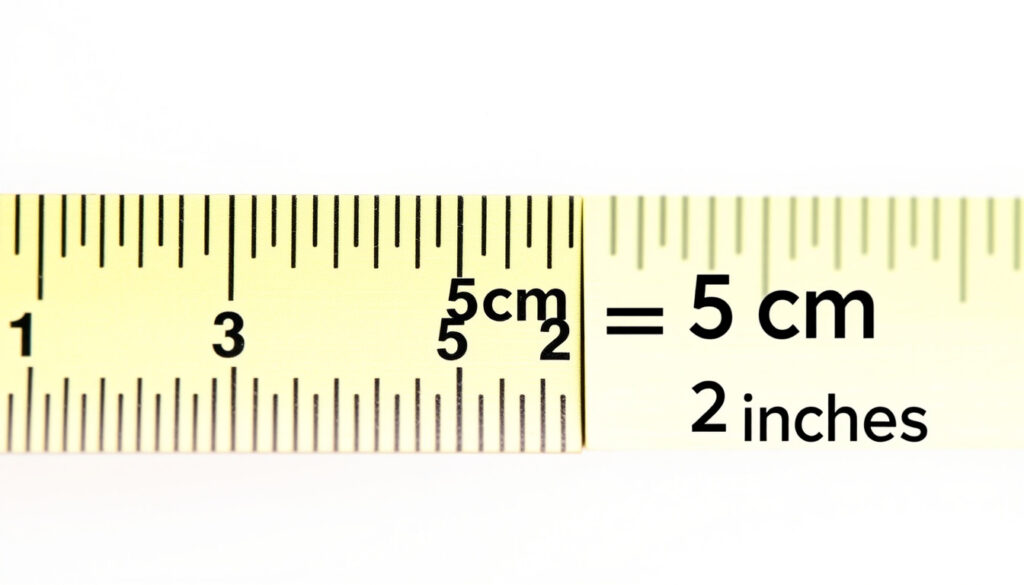
On a metric ruler, 5 cm is five major marks from the zero point. Each line represents 1 cm, so 5 cm is the fifth long line. For quick reference, look for the “5” label along the centimeter scale.
What this means: 5 cm is a moderate, easy-to-visualize length — about the width of a hand’s palm at its narrowest point. It’s small enough to fit in your pocket but large enough to measure deliberately.
What does 2 inches look like?
Since 2 inches is the value people often confuse with 5 cm, seeing exactly what 2 inches looks like helps draw the distinction.
Visualizing 2 inches
- Thumb joint length: The distance from the tip of your thumb to the first knuckle is approximately 1 inch. Two stacked thumb segments equal roughly 2 inches. (LingoAce)
- Business card width: A standard business card is exactly 2 inches wide — an excellent real-world ruler. (MISUMI USA)
- Soda can diameter: A typical soda can measures about 2.6 inches across — larger than 2 inches. (SplashLearn)
How big is 1 inch visually?
The width of an adult thumb (not the full thumb, just the width) is roughly 1 inch. Two thumb widths side by side give you a solid 2-inch reference. (Study.com)
The pattern: 2 inches is smaller than most people expect — it’s closer to the width of a large egg than the length of a smartphone. That’s exactly why 5 cm (1.97 inches) looks almost identical to the untrained eye.
Is 5 cm big or small?
The answer depends entirely on what you’re measuring. There is no universal threshold — context defines whether 5 cm is large or small.
Context matters: where 5 cm is considered large
- Jewelry: A 5 cm pendant is large for a necklace; typical pendants fall in the 2–3 cm range.
- Medical imaging: A 5 cm mass or tumor is clinically significant and usually warrants further investigation. (SplashLearn)
Where 5 cm is small
- Household items: A typical dinner plate has a diameter of 25–30 cm, making 5 cm a tiny fraction.
- Furniture: The depth of a bookshelf or the height of a chair leg far exceeds 5 cm.
Why this matters: Without context, “Is 5 cm big?” is an unanswerable question. Always anchor size comparisons to the object you’re talking about — a 5 cm tumor is alarming; a 5 cm button is normal.
How to measure 2 inches with a finger?
When you don’t have a ruler handy, your own hand can serve as a reliable measuring tool. These methods work because the average adult hand has fairly consistent proportions.
Using your thumb as a guide
- Thumb tip to first knuckle: The distance from the tip of your thumb to the first knuckle joint is approximately 1 inch. Two such segments stacked give you 2 inches. (LingoAce)
- Two finger widths: Press your index and middle fingers together. The combined width of both fingers is roughly 2 inches for most adults.
No-ruler tricks for measuring inches
- US dollar bill: A dollar bill is 2.61 inches tall — close enough to estimate 2 inches.
- Credit card length: A standard credit card is 3.38 inches long. Half of that gives you just under 2 inches.
Hand-based measurements are handy but not precise. For exact work, use a ruler. For a quick sanity check, your thumb works well — just be aware of individual variation.
Comparison: 5 cm versus 2 inches
Four key differences, one pattern: the gap is small but real.
| Attribute | 5 cm | 2 inches |
|---|---|---|
| Exact value in opposite unit | 1.9685 inches | 5.08 cm |
| Rounded decimal (2 dp) | 1.97 inches | 5.08 cm |
| Common visual reference | Credit card width (approx) | Business card width |
| Mental math shortcut error | Divide by 2.5 gives 2.0 inches (+0.03) | Multiply by 2.5 gives 5 cm (−0.08) |
The implication: The gap is small enough to ignore for casual use but significant for precision work.
How to Convert 5 cm to Inches (Step-by-Step)
Whether you need an exact or estimated conversion, follow these steps:
Step 1: Know the conversion factor
- 1 inch = 2.54 cm exactly. (NIST)
Step 2: Divide centimeters by 2.54
- 5 cm ÷ 2.54 = 1.9685 inches. (BYJU’S)
Step 3: Round as needed
- For most practical purposes, round to two decimal places: 1.97 inches. (Study.com)
Step 4: Use a mental shortcut for approximates
- Divide by 2.5 instead of 2.54 to get 2.0 inches — quick but approximate. (LingoAce)
The implication: Choose the exact method when precision matters (e.g., woodworking, science). For cooking or rough estimates, the shortcut is fine — just remember you’re adding a small error.
Confirmed facts
- 5 cm = 1.968503937 inches (exact) (NIST)
- 2 inches = 5.08 cm (exact) (BYJU’S)
Common myths
- “5 cm equals exactly 2 inches” — false; the difference is 0.0315 inches.
- “Divide by 2.5 gives an exact conversion” — false; it’s a rough approximation.
“There are 1.969 inches in 5 centimeters.”
— CK-12 Foundation (Flexi), educational math resource
“To convert 5 cm into inches, multiply 5 cm by 0.393701 inches. = 1.9685 inches.”
— Byju’s Math Department
For anyone frequently switching between metric and imperial systems, the decision is straightforward: use the exact 2.54 divisor for precision work, or accept the rounding error of the divide-by-2.5 shortcut for quick estimates. Doing otherwise risks a 0.03-inch mismatch — small, but enough to throw off a tight fit in DIY or engineering projects.
Related reading
- 20 Celsius to Fahrenheit: 68°F Conversion & Comfort Guide — another essential unit conversion guide.
- 160 MPH to KMH – Exact Conversion and Formula — speed conversion explained.
For another example that frequently confuses people, the conversion of 10 cm to inches clarifies a similar common myth.
Frequently asked questions
How many inches is 5 cm exactly?
5 cm equals exactly 1.968503937 inches, or 1.9685 inches when rounded to four decimal places. The exact conversion is based on the international inch definition of 2.54 cm per inch. (NIST)
What is 5 cm in inches as a fraction?
5 cm is approximately 1 31/32 inches. The exact fraction would be 5000/2540 inches, which simplifies to 1 2460/2540. In practice, 1 31/32 is a close enough representation for most uses. (SplashLearn, math education resource)
Why is 5 cm not exactly 2 inches?
Because 1 inch is defined as 2.54 cm. To find how many inches in 5 cm, you divide 5 by 2.54, which yields 1.9685, not 2. The common shortcut of dividing by 2.5 gives exactly 2, but that method is an approximation, not the precise conversion. (LingoAce, an online learning platform)
What common objects are 5 cm long?
Objects around 5 cm include the width of a credit card, the diameter of a golf ball (about 4.3 cm), the length of a large strawberry, or the height of a stack of about 16 paperclips. (MISUMI USA, industrial conversion guide)
How to convert 5 cm to inches without a calculator?
Use the mental shortcut: divide 5 by 2.5 to get 2 inches (approximate). For a more accurate result, remember that 1 cm is just under 0.4 inches, so 5 cm is just under 2 inches. Hand measurements: your thumb width is about 1 inch, so two thumb widths give you a rough 2 inches. (LingoAce)
More related posts
 How Much Do Air Canada Flight Attendant Make? (2025 Pay)
 AT&T Stock: Buy, Sell, or Hold? 2025 Forecast & Analysis
 Canada Postal Workers Strike Update: Latest Vote and Status
 Cast of Crocodile Dundee: Paul Hogan, Linda Kozlowski, and More
 Zdeno Chara: Height, Career, Family, NHL’s Tallest
 Benefits of Chia Seeds – For Heart, Digestion and Weight Loss
 How Many KM is a Marathon? 42.195 km Exact Distance
 Open Source Note Taking Apps – Best Verified Privacy Options
