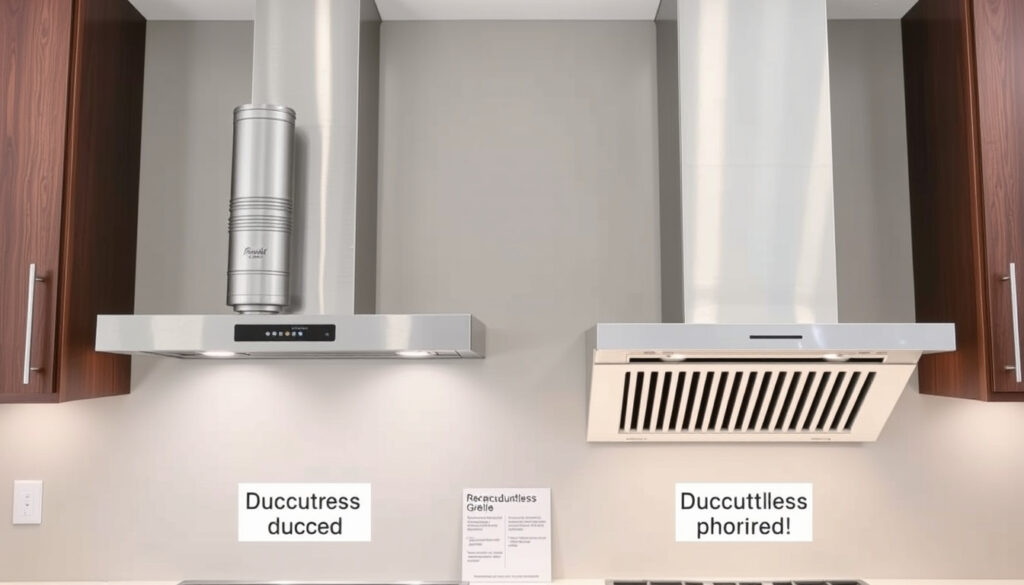
Range Hood Buying Guide: Ducted vs Ductless 2025 Tips
Ask anyone who’s tried to sear a steak in an Irish flat with no window, and they’ll tell you the same thing: kitchen smoke settles into everything — the difference between a good meal and a foggy kitchen often comes down to one quiet appliance sitting above the hob. This guide walks through the real trade-offs between ducted and ductless range hoods, with a particular eye on the building stock and cooking habits that make the choice different in Ireland and the UK.
Households with a range hood in the UK/Ireland: over 80% of modern kitchens ·
Venting efficiency gain over recirculating: up to 95% removal of smoke, steam, odors ·
Typical noise level (ducted vs ductless): ducted ~40 dB(A), ductless ~55 dB(A) ·
Average cost range (install + unit): €150 – €1,200
Quick snapshot
- Modern ducted hoods capture at least 90% of cooking pollutants (Consumer Reports buying guide)
- Recirculating hoods lose about 30% of filtration efficiency over time if filters aren’t changed (Consumer Reports range hood roundup)
- Exact energy savings from ductless vs ducted installations vary by household
- Long-term impact of recirculated air on indoor humidity in colder climates
- Consumer Reports published its annual best range hoods roundup on 2026-01-01 – this category is actively reviewed (Consumer Reports)
- Hybrid convertible hoods are becoming common, offering flexibility for future renovations (The Range Hood Store)
Key range hood facts at a glance:
| Fact | Detail |
|---|---|
| Primary function | Extract cooking fumes, grease, and moisture |
| Minimum ventilation rate (UK building regs) | 30 litres/sec over hob |
| Typical noise level range | 35–65 dB(A) |
| Filter replacement (ductless) | Every 3–6 months, depending on usage |
What is a range hood?
A range hood is essentially a powered ventilator positioned directly above your hob that sucks up smoke, steam, grease, and cooking odours before they settle on your cabinets. According to Consumer Reports (appliance testing authority), the core job is maintaining kitchen air quality, and the market has settled into two main categories: ducted (which vents air outdoors through pipework) and ductless (which passes air through a charcoal filter and recirculates it).
Modern ducted hoods capture at least 90% of cooking pollutants.
Core functions of a range hood
- Removes smoke, steam, grease, and odours from the cooking area
- Helps maintain kitchen air quality and reduces condensation on walls and windows
- Available in ducted (external venting) and ductless (recirculating) types
Key components: fan, filters, ducting vs recirculation
Every hood contains a fan motor, some kind of grease filter (mesh or baffle), and either a duct connection or a charcoal filter. The Airhood (specialist ventilation resource) explains that the fan moves air at a rate measured in CFM (cubic feet per minute) or m³/h while the filter type determines whether air leaves the room or stays in it.
The fan moves air at a rate measured in CFM or m³/h while the filter type determines whether air leaves the room or stays in it.
If you regularly fry bacon or cook curries, a ducted hood removes moisture and odours before they can condense on walls. A ductless hood will capture grease but leaves steam in the room, which can lead to damp issues in older Irish terraced houses with limited background ventilation.
Do range hoods need to be vented outside?
Technically no – but whether you should vent outside depends on your kitchen, your cooking, and your local building regulations. Here’s the breakdown.
Advantages of vented (ducted) installation
- Ducted hoods remove moisture, smoke, and odours far more effectively than recirculating units
- They are generally quieter because the fan can be mounted remotely in the duct run
- They help meet minimum ventilation rates required by building codes for new kitchens
When ductless recirculating hoods are a practical alternative
Ductless hoods use charcoal filters to trap grease and odours, then push cleaned air back into the kitchen. Consumer Reports (independent testing authority) notes that ductless hoods are popular in apartments, listed buildings, or any kitchen where running ductwork to an exterior wall is structurally or financially impractical. Harvey Norman Ireland (major Irish appliance retailer) sells both ducted and ductless models, confirming that ventless options are a standard offering in the Irish market.
Building regulations and existing ductwork
Irish building regulations Part F (official government ventilation standards) require mechanical ventilation for new kitchens, with a minimum extraction rate of 30 litres per second over the hob. For gas hobs, local codes may require ducted venting to remove combustion products. The HSE (Irish health service guidance) emphasises that proper kitchen ventilation reduces indoor air pollutants and moisture, which is particularly relevant for homes with solid fuel stoves or poor background ventilation.
A ductless hood can meet regulatory minimums for air movement but does not actually remove moisture. In a modern airtight Irish home, that’s a condensation risk that a ducted hood simply avoids by pushing the humid air outside instead of recycling it.
The trade-off: ductless models solve an installation problem but create a latent humidity problem that only becomes visible when mould begins forming on window frames.
Ducted vs. Ductless Range Hoods: Which One to Buy?
The core difference is simple but the decision affects cost, noise, and kitchen air quality for years. One pattern: ducted moves air out, ductless cleans air in.
| Feature | Ducted (Vented) | Ductless (Recirculating) |
|---|---|---|
| Air handling | Exhausts air outside | Filters and recirculates air |
| Moisture removal | Excellent – removes steam entirely | Poor – steam stays in the room |
| Installation cost | €300–€1,200 (plus ductwork) | €150–€500 (no ductwork) |
| Noise level | ~40 dB(A) (remote fan option) | ~55 dB(A) (fan inside unit) |
| Filter maintenance | Grease filter cleaning only | Grease filter + charcoal filter replacement every 3–6 months |
| Retrofit difficulty | High – needs duct run to exterior wall | Low – fits any hob location |
| Best for | Heavy cooking, gas hobs, new builds | Apartments, listed buildings, rental kitchens |
Performance comparison: airflow, filtration, noise
- Ducted systems are more powerful and preferred for heavy cooking – they capture at least 90% of airborne cooking pollutants
- Ductless units are easier to retrofit and cost less to install, but lose about 30% filtration efficiency if charcoal filters aren’t changed every 3–6 months
- Hybrid convertible hoods exist and can be switched between ducted and ductless modes depending on future renovations
Installation requirements and costs
Screwfix Ireland (building trade supplier) stocks ducting components, confirming that even DIY installation of a ducted system is possible for competent homeowners, though electrical hardwiring must be done by a qualified professional. Joyces Ireland (Irish appliance retailer) offers dedicated recirculating cooker hoods online, showing that ductless models are a ready option for the Irish market.
Best choice for different kitchen layouts
For open-plan living spaces where the kitchen flows into a sitting area, a ducted hood is strongly preferred because it physically removes cooking smells rather than filtering them. For a flat in a Georgian building where you cannot cut through a listed façade, a ductless model with high-quality charcoal filters is the only realistic option.
The choice hinges on your building’s ability to accommodate ductwork.
What is the best type of range hood for your home?
Beyond the ducted/ductless choice, the physical shape of the hood matters almost as much for capture performance. Here’s how the main styles compare.
Wall-mounted vs island vs under-cabinet vs canopy
- Wall-mounted chimney hoods – Most common in UK and Irish kitchens. Mount against the wall behind the hob. Good capture area. Harvey Norman Ireland (national retailer) lists chimney models like the Belling 60cm Curved Glass Chimney Hood.
- Island hoods – Require ceiling ducting, which limits retrofit options. Best for large open kitchens where the hob sits on a central island.
- Under-cabinet hoods – Compact, slide beneath a wall cabinet. Typically have smaller capture areas and lower CFM ratings.
- Canopy hoods – Offer the widest capture area. Often used in professional-style kitchens or where the hob is wider than standard 60 cm.
Size matching: hood should be at least as wide as the hob
A 60 cm hob pairs with a 60 cm hood as the minimum. Going wider – e.g., a 90 cm hood over a 60 cm hob – improves capture performance because the fan draws air from a larger surface area.
CFM rating and noise level considerations
CFM (cubic feet per minute) measures how much air the fan moves. For heavy cooking, aim for at least 600 CFM. But higher CFM often means more noise. According to Consumer Reports (appliance testing authority), ducted hoods with a remote fan can be significantly quieter than comparably rated ductless units that pack the motor directly above your head.
Range hood types vary in capture width, CFM, and noise.
| Type | Capture width | CFM range | Noise (dB(A)) | Best for |
|---|---|---|---|---|
| Wall-mounted chimney | 60–90 cm | 400–900 CFM | 40–55 | Standard kitchen layouts |
| Island | 60–120 cm | 500–1100 CFM | 45–60 | Open-plan island hobs |
| Under-cabinet | 60–76 cm | 300–600 CFM | 50–65 | Small kitchens with low clearance |
| Canopy | 90–120 cm | 600–1200 CFM | 45–65 | Professional-style cooking |
Are range hoods outdated?
Some modern kitchen designs try to eliminate the hood entirely with downdraft hobs or minimalist extractors. The short answer: range hoods are not outdated – they are evolving.
Modern kitchen trends 2025: what’s in and what’s out
- Sleek, integrated hoods that hide behind cabinet panels or drop down from the ceiling – these are on-trend
- Smart hoods with app controls, auto-dimming lights, and sensor-based fan speed adjustment
- Downdraft hobs (extraction from the hob itself) exist but are less effective at capturing steam and odours compared to an overhead hood
Why range hoods remain essential for ventilation
The HSE (Irish health authority guidance) states that proper kitchen ventilation reduces indoor air pollutants, and removing the hood entirely is discouraged for both safety and air quality reasons. The minimum requirement of 30 litres per second over a hob, per Irish building regulations, cannot effectively be met by any other single appliance.
Styling options to keep your hood current
Manufacturers like Bosch Home Ireland offer integrated models that sit flush with cabinets, invisible until needed. Harvey Norman Ireland lists a Bosch Series 2 60cm Integrated Cooker Hood designed for exactly this discreet look.
Removing a range hood to chase a ‘cleaner’ look increases humidity and grease accumulation in the kitchen, which in old brick-built Irish houses can accelerate mortar decay and paint peeling. The hood isn’t the problem – poor filter maintenance is.
Upsides
- Ducted models remove moisture, smoke, and odours effectively
- Ductless models offer easy retrofit for apartments and listed buildings
- Wide range of styles to match any kitchen design
- Improves indoor air quality and reduces cleaning burden on surfaces
Downsides
- Ducted installation can be expensive and disruptive in existing homes
- Ductless hoods require ongoing filter replacement costs (€20–€50 every 3–6 months)
- Ductless units do not remove moisture, creating humidity risks
- Noise levels can be high, especially in ductless units with the fan near ear level
youtube.com, hauslane.com, youtube.com, therangehoodstore.com, reddit.com, youtube.com
For a deeper look at the cost and lifespan differences between ducted and ductless systems, the guide from North Brief offers a practical breakdown of what to expect over time.
Frequently asked questions
How does a range hood differ from an extractor fan?
The terms are often used interchangeably, but an extractor fan is typically a wall or window fan while a range hood sits directly above the hob. Both remove steam and odours.
What size range hood do I need for a 60 cm hob?
Choose a hood at least as wide as your hob. A 60 cm hob pairs with a 60 cm hood; larger is better for capture.
Do I need a professional to install a range hood?
Electrical hardwiring or duct work requires a qualified installer. Simple plug-in models can be DIY.
Can a ductless hood be retrofitted into a ducted system?
Yes, many hoods support both modes. Check if the model includes a damper and can switch to ducted with the right kit.
What is the best material for a range hood filter?
Stainless steel baffles trap grease effectively; charcoal filters are used in recirculation mode and need periodic replacement.
What CFM rating do I need for heavy cooking?
Aim for at least 600 CFM. For lighter cooking, 400 CFM is normally sufficient. Match CFM to your hob’s heat output: roughly 100 CFM per 10,000 BTUs of stove output.
Is a recirculating range hood effective in a rental apartment?
It is the only realistic option if no exterior wall is available. Effectiveness depends on changing the charcoal filter every 3 months.
Do modern kitchens still use range hoods?
Yes – over 80% of modern kitchens in the UK and Ireland include one. They are evolving in design but remain essential for ventilation and safety.
For Irish and UK homeowners renovating a kitchen, the choice is clear: if your building allows ducting to an exterior wall, invest in a ducted hood with at least 600 CFM and a baffle filter. If you live in an apartment or a listed structure where external venting is impossible, accept that a ductless hood is a compromise and budget for charcoal filter replacements every quarter – or find a way to add supplementary background ventilation to prevent moisture problems.
More related posts
 Largest Province in Canada: By Area, Population & Rankings
 45 Euro to CAD – Live Rate, Converter Comparison and Trends
 Cast of The Residence (TV Series): Full List & Roles
 Adjectives to Describe Someone: 300+ Words & Personality Traits
 Sophia Laforteza: Religion, Nationality, and Role in KATSEYE
 Ford F-150 Lightning: Price, Specs, Problems & Sales 2025
 India vs Pakistan Match: Head-to-Head Record & Live Streaming
 U19 Cricket World Cup Standings 2026: Points & Scenarios
