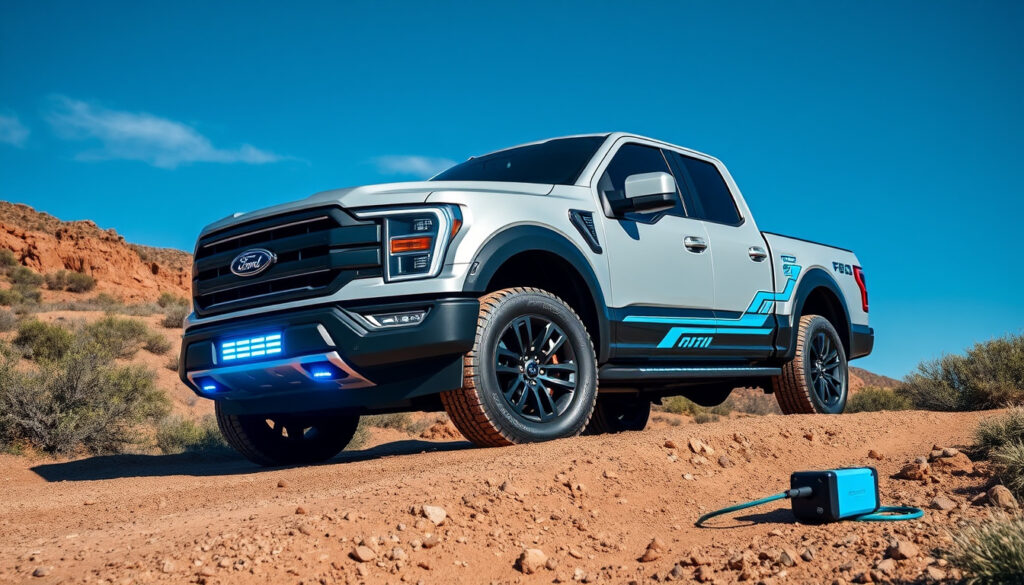
Ford F-150 Lightning: Price, Specs, Problems & Sales 2025
Ford called the F-150 Lightning an electric revolution for America’s best-selling truck. Three years later, that revolution stalled: prices climbed past what core buyers would pay, software gremlins plagued the lineup, and sales never recovered from a 42% demand crash. By late 2025, Ford confirmed what owners and analysts had feared — the Lightning experiment was over.
Model Year: 2025 · Powertrain: Battery Electric · Body Style: Full-Size Pickup · Unveiled: May 2021 · Key Feature: Extended Range Battery
Quick snapshot
- 100% electric powertrain with no gas engine option (Car and Driver)
- 2025 Pro trim starts at $49,875, down $7,215 from 2024 (Car and Driver)
- Production halted November 15, 2024 – January 6, 2025 (Car and Driver)
- Exact date Ford publicly confirmed discontinuation
- Total financial losses specific to Lightning program
- Official specs for any future EREV replacement
- Ford pivoting to hybrids and extended-range EVs
- Remaining inventory likely available through 2026
- Used Lightning prices may climb as supply shrinks
Core specifications reflect Ford’s electric pickup ambitions and the market reality that followed.
| Specification | Detail |
|---|---|
| Type | Battery Electric Pickup Truck |
| Current Model | 2025 F-150 Lightning |
| Key Options | Home Backup Power |
| Launch | May 2021 |
| Production Pause | Nov 15, 2024 – Jan 6, 2025 |
| 2025 Pro Starting Price | $49,875 |
How much does a Ford F-150 Lightning truck cost?
When Ford unveiled the Lightning in May 2021, it promised a base price around $39,995 — competitive with work-truck gas F-150s. Then supply chain chaos hit. By launch in 2022, the real starting price sat $20,000 higher, and by 2024 the Pro model hit $57,090. That 30%+ increase from original promises priced out the contractor crowd Ford targeted.
2025 Ford F-150 Lightning Trim Levels By Price
Ford attempted a price correction for 2025, cutting the Pro from $57,090 down to $49,875 — a $7,215 reduction. Other trims saw smaller adjustments mid-2024: XLT dropped $2,000, Flash fell $5,500, and Lariat dropped $2,500. Still, Lightning commanded $10,000–$15,000 more than comparable gas F-150s.
The 2026 Pro model reverses course, jumping $5,000 due to battery changes. Ford discontinued the Standard Range battery option, leaving only Extended Range configurations — pushing base prices higher still.
What are the common problems with F-150 Lightning?
The 2025 model year brought new equipment deletions that frustrated buyers: Ford removed the Interior Worksurface from XLT and Flash trims, deleted bed storage boxes and onboard scales entirely, and replaced spare tires with repair kits. Beyond convenience cuts, owners faced persistent technical issues.
Ford F-150 Lightning Common Problems & Fixes
Recalls hit 2022–2024 models for high-voltage battery cell defects — misaligned electrodes risked thermal events, and Ford limited affected owners to 80% charge as a precaution (Recharged). Software proved equally troublesome: phantom error messages, inconsistent BlueCruise hands-free driving, and frozen infotainment screens plagued daily driving.
Buyers who paid $55,000–$75,000 for a Lightning faced both range limitations (most got 210–240 miles real-world) and repair complexity unique to EV pickups. Body shops unfamiliar with high-voltage systems added tow bills and delays.
Is the Ford Lightning 100% electric?
Yes — the F-150 Lightning is a pure battery electric vehicle with no gas engine option whatsoever. Dual electric motors drive all four wheels, drawing from either the Standard Range (98 kWh) or Extended Range (131 kWh) battery pack. The onboard frunk replaces where a traditional engine would sit.
F-150 Lightning — Key Electric Features
The Extended Range battery enabled roughly 320 miles EPA-rated range, though real-world driving in cold weather or with heavy loads dropped that to 210–240 miles. Ford marketed the Intelligent Backup Power feature, letting Lightning owners power their homes during outages — a genuinely useful capability that distinguished it from competitors.
Why is the F-150 Lightning not selling?
Ford hoped for 150,000 annual Lightning sales. The reality never came close. Q3 2024 brought 22,807 units — up from 12,260 in Q3 2023, but still far below targets. October 2025 painted an uglier picture: just 1,543 Lightnings sold, down from 1,863 in October 2024 and a steep drop from 3,957 in September 2025.
The Rapid Rise and Fall of the Ford F-150 Lightning
Early demand at launch was real — Ford couldn’t build enough initially. Then the price increases hit, federal tax credits expired or didn’t apply, and Cybertruck stole headlines. Sales fell when incentives dried up. Competitors like Rivian R1T, GMC Hummer EV, and even Tesla’s Cybertruck also struggled, suggesting market timing mattered — but Lightning also priced itself out of its core audience.
Ford lost billions on its dedicated EV division. By late 2025, the automaker made clear it was ending the all-electric Lightning experiment and pivoting to hybrids and extended-range EVs — a strategy shift CEO Jim Farley reportedly confirmed two weeks after a White House appearance.
Ford’s inability to make Lightning profitable despite strong brand recognition and early demand suggests the market wasn’t ready for a pure electric work truck at the price point required.
What is the battery life expectancy on a lightning?
Ford hasn’t published official battery longevity specs for the Lightning, but industry standards suggest 70–80% capacity retention after 150,000 miles for lithium-ion packs similar to those in the Extended Range configuration. The 2024 recall affecting battery cells in 2022–2024 models introduced additional uncertainty for early buyers.
How Long Does the F-150 Lightning Really Last?
Real-world owners report 210–240 miles per charge in normal conditions, dropping to 160–180 miles in cold weather with heavy loads. Ford’s Intelligent Range system improved accuracy over time, but the gap between EPA estimates and highway driving remained frustrating for long-distance haulers. The 98 kWh Standard Range pack proved limiting for buyers who needed tows beyond 50 miles.
For fleet buyers seeking to replace gas work trucks, Lightning batteries needed to survive daily heavy loads and fast charging cycles. Early data suggests the Extended Range pack handles this reasonably well, but Ford’s silence on long-term degradation left buyers guessing.
The pattern shows Ford struggled to validate battery durability claims while competitors moved toward hybrid solutions that reduce range anxiety for work-truck buyers.
Trim levels and pricing reflect how Ford positioned each variant for different buyer priorities.
| Trim | 2025 Base Price | Key Features |
|---|---|---|
| Pro | $49,875 | Standard Range battery, work-focused |
| XLT | ~$53,000 | Larger battery option, more comfort features |
| Flash | ~$58,000 | Extended Range standard, tech-heavy |
| Lariat | ~$63,000 | Leather interior, premium audio |
| Platinum | ~$77,000 | Full luxury, BlueCruise included |
| Harley-Davidson | ~$90,000 | Limited edition, maximum features |
Upsides
- Instant torque and smooth acceleration
- Intelligent Backup Power for home during outages
- Lower fuel costs vs. gas F-150
- No tailpipe emissions in daily driving
- Massive front trunk (frunk) storage
- OTA software updates improved features over time
Downsides
- Priced $10,000–$15,000 above gas equivalent
- Real-world range 210–240 miles only
- Cold weather severely impacts range
- Battery cell recall for 2022–2024 models
- Limited charging infrastructure in rural areas
- Repair complexity for high-voltage issues
- Software glitches and frozen screens
- Never reached profitability despite early demand
Key Timeline
The timeline below captures Ford’s electric truck ambitions from launch through discontinuation reports.
| Date/Period | Event |
|---|---|
| May 2021 | Ford unveils F-150 Lightning |
| 2022 | Launch year — early demand surge |
| 2024 | Mid-year price cuts across trims |
| November 15, 2024 | Production pause begins |
| January 6, 2025 | Planned production restart |
| Late 2025 | Ford reportedly ends Lightning production permanently |
What Analysts Say
Lightning never reached profitability despite early demand and federal tax incentives. Ford hoped 150,000 annual sales; the reality fell catastrophically short.
By late 2025, Ford made it clear the all-electric Lightning experiment was over, pivoting to hybrids and extended-range EVs after sustained losses.
— Recharged EV-focused news outlet
Ford lost billions on its dedicated EV division, and Lightning was the most visible symbol of that struggle.
— Recharged
The Lightning’s fate illustrates a brutal truth about EV adoption in work-truck segments: price sensitivity is extreme, range anxiety is real, and early adopters willing to pay premiums for novelty are a small market. Ford’s $7,215 price cut for 2025 came too late — after years of eroded trust and buyers who moved to Rivian alternatives or stuck with gas F-150s.
Related reading: USD to CAD exchange rate · USD to CAD converter
cleantechnica.com, youtube.com, f150lightningforum.com, youtube.com
Amid struggling sales, savvy buyers can scout 2025 Ford Lightning deals for new and used options that fit tight budgets.
Frequently asked questions
What is the range of the Ford F-150 Lightning?
The Extended Range battery delivered EPA estimates of roughly 320 miles, but real-world driving typically yielded 210–240 miles. Cold weather and heavy loads reduced this further, making the Lightning practical for local work routes but challenging for long-distance hauling.
Is the Ford F-150 Lightning for sale?
The 2025 model remains available while supplies last. Ford reportedly ended production by late 2025, so remaining inventory should be found at dealerships through mid-2026. The 2026 Pro trim sees a $5,000 price increase due to battery changes.
What are Ford F-150 Lightning 2026 plans?
The 2026 Lightning Pro gets a $5,000 base price increase and Ford discontinued the Standard Range battery, leaving only Extended Range options. Beyond that, Ford is pivoting to hybrid and extended-range EV technologies rather than pure electric trucks.
Which F-150 engine to avoid?
This question typically refers to the 3.5L EcoBoost twin-turbo V6 in gas models, which has had some reports of carbon buildup issues. For Lightning specifically, avoid early 2022–2024 models subject to battery cell recalls until Ford releases software fixes.
Ford F-150 Lightning 2000 vs new?
There was no 2000-model Lightning — the nameplate began in 2022 as Ford’s first full-electric F-150. The “2000” likely references the 2000-lb payload capacity or a misremembered year for the earlier F-150 Heritage body style.
What makes F-150 Lightning Platinum special?
The Platinum trim offered the full luxury experience: premium leather interior, upgraded B&O sound system, 22-inch wheels, BlueCruise hands-free driving included, and the most complete feature set. Starting around $77,000, it targeted buyers wanting an electric truck that felt like a Tesla rival.
Why did Ford discontinue the Lightning?
Ford lost billions on its EV division, and Lightning sales never recovered after prices climbed 30%+ from original promises. Competition intensified, federal incentives lapsed, and buyers returned to gas F-150s — making the pivot to hybrids and extended-range EVs Ford’s chosen path forward.
How many Lightning trucks did Ford sell?
Since the 2022 launch through Q1 2025, Ford sold approximately 80,000 Lightning units total — well below the 150,000 annual target. October 2025 saw just 1,543 units sold, showing demand had collapsed almost entirely.
More related posts
 Russian AI Robot Falls Flat Seconds After Moscow Debut
 Coupe du Monde de Football 2026 – Everything You Need to Know
 Telus Stock Price TSX – Live Price, Charts and Analysis
 Adjectives to Describe Someone: 300+ Words & Personality Traits
 Largest Province in Canada: By Area, Population & Rankings
 A Deadly American Marriage: The Jason Corbett Case Explained
 Pâte à Pizza Maison: Tips for Perfect Homemade Pizza Dough
 DoubleTree by Hilton Toronto – Location, Amenities, Reviews
