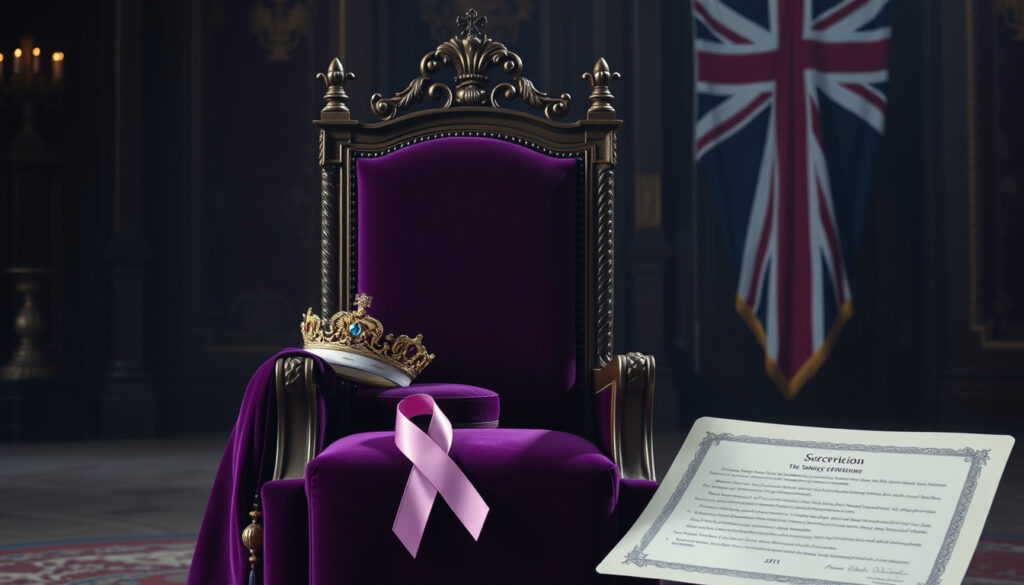
King Charles cancer diagnosis and succession updates
Few pieces of news in 2024 landed with the weight of Buckingham Palace’s announcement on 5 February: King Charles III had been diagnosed with cancer, opening a new chapter of uncertainty for the monarch and the monarchy’s future. Here’s what is confirmed, what remains unclear, and what the line of succession means for Prince William, Kate Middleton, and the crown.
Age at accession: 73 years ·
Years as heir apparent: 64 years ·
Coronation date: 6 May 2023 ·
Current age: 76 (as of 2025) ·
Spouse: Queen Camilla
Quick snapshot
- King Charles became monarch on 8 September 2022 (The Royal Family – official succession page)
- Diagnosed with cancer on 5 February 2024 (BBC – palace announcement)
- Married to Queen Camilla since 2005 (BBC royal family tree)
- Prince William is first in line to the throne (BBC royal family tree)
- Specific type of cancer King Charles has
- Complete prognosis or life expectancy
- Detailed treatment plan
- Claims about private conversations between Charles and Diana
- 5 Feb 2024: cancer diagnosis announced (BBC)
- 26 Jan 2024: treatment for enlarged prostate at London Clinic (BBC)
- Dec 2024: royal source said treatment continues into 2025 (Business Insider – royal source)
- Dec 2025: Charles shares treatment will be reduced in 2026 (People – magazine report)
- Charles continues treatment as a managed condition (Business Insider)
- Prince William gradually assumes more public duties (Business Insider)
- Succession plan remains unchanged by law (Business Insider)
Seven key facts about King Charles III, drawn from official records and verified reporting:
| Label | Value |
|---|---|
| Full name | Charles Philip Arthur George |
| Title | King of the United Kingdom |
| Born | 14 November 1948 |
| Reign started | 8 September 2022 |
| Coronation | 6 May 2023 |
| Spouse | Queen Camilla |
| Children | Prince William, Prince Harry |
What is the sad news about King Charles?
The news that shook the monarchy came on 5 February 2024, when BBC (leading UK news outlet) reported that Buckingham Palace announced that King Charles III had been diagnosed with a form of cancer. The diagnosis was discovered during tests following treatment for an enlarged prostate — a separate issue that had been disclosed weeks earlier.
The palace stated that the King had begun a schedule of regular treatments immediately and was advised by doctors to postpone public-facing duties while continuing state business and official paperwork. BBC (trusted UK broadcaster) reported that Charles remained positive about treatment and looked forward to returning to full public duty as soon as possible.
Cancer diagnosis announcement from Buckingham Palace
- Announcement made on 5 February 2024 (BBC – palace statement)
- King chose to share the diagnosis to help prevent speculation and aid public understanding (BBC)
- Prostate treatment had been announced on 17 January 2024 (BBC timeline)
Current treatment and public appearances
- Received treatment for enlarged prostate on 26 January 2024 at the London Clinic (BBC)
- Left hospital on 29 January 2024 after three nights (BBC)
- First public outing after treatment: attending church in Sandringham on 4 February 2024 (BBC)
- In April 2024, palace said Charles would soon return to public duties (Business Insider – royal source)
- As of December 2024, a royal source confirmed treatment would continue into 2025 (Business Insider)
The palace’s strategy of proactive disclosure — rare for a British monarch — has shifted the public conversation from speculation to managed facts. For the royal household, the trade-off is clear: transparency buys goodwill but invites continuous scrutiny of every public appearance.
What is King Charles diagnosed with?
Buckingham Palace confirmed a cancer diagnosis but did not specify the type. BBC (authoritative news source) reported that the palace explicitly said it was not prostate cancer, but was discovered during treatment for benign prostate enlargement. This distinction is important: the cancer was found incidentally, not as a progression of the prostate condition.
Official statements on the type of cancer
- No specific type disclosed by the palace (BBC)
- Not prostate cancer (BBC)
- Described as a “form of cancer” (BBC)
Comparison to other royal health disclosures
- Queen Elizabeth II’s health was largely kept private until her final months
- Prince Harry’s memoir “Spare” disclosed personal health details
- Kate Middleton’s 2024 abdominal surgery was announced with similar brevity
The palace’s refusal to name the cancer creates a vacuum that media speculation fills. For readers, the key metric isn’t the type — it’s the treatment trajectory. A managed condition that allows public duties is a different signal from one that requires extended absence.
The catch: without a named diagnosis, every subsequent public appearance becomes a diagnostic clue. The palace’s control over the narrative is both a strength and a vulnerability.
How long is King Charles expected to live?
No official prognosis has been released by royal doctors or the palace. BBC (trusted UK broadcaster) confirmed that the palace has not issued any life expectancy guidance. Media reports that speculate on a timeline are based on unnamed sources and should be treated as unconfirmed.
In December 2025, People magazine (royal reporting outlet) reported that Charles shared a cancer-treatment update indicating treatment would be reduced in 2026. That suggests a managed condition rather than a terminal trajectory, but no definitive timeline exists.
The absence of a prognosis is a deliberate choice to keep the focus on continuity.
What will happen when Prince William dies?
The question rests on a hypothetical that has no current trigger — Prince William is 43 and in good health. But the line of succession is fixed by law. If William were to die, his eldest son Prince George would become heir apparent. The Royal Family (official monarchy website) defines succession as the sequence of members in line to the throne, governed by the Succession to the Crown Act 2013, which replaced male-preference primogeniture with absolute primogeniture.
Line of succession after William
- Prince George (born 2013) – second in line now, would become first if William dies before Charles
- Princess Charlotte (born 2015) – third in line
- Prince Louis (born 2018) – fourth in line
- Prince Harry (born 1984) – fifth in line, but would be bypassed if George is old enough
Changes to the monarchy structure
- Succession rules are established by law, not royal discretion (BBC royal family tree)
- A regency would be required if the new monarch is under 18 (as George would be in the near future)
- William’s death would accelerate the transition to the next generation, but the constitutional framework remains unchanged
Three monarchs, one pattern: each generation inherits the crown at a different age and with a different level of preparation. The table below compares the current monarch and his two immediate successors based on their age at key milestones.
| Monarch | Age at accession | Years as heir apparent | Age at coronation |
|---|---|---|---|
| King Charles III | 73 | 64 | 74 |
| Prince William (future) | Will be 40+ (current age 43) | Approx. 1 year (so far) | TBD |
| Queen Elizabeth II | 25 | 25 | 27 |
What will Kate be called if William becomes king?
When Prince William becomes king, his wife Catherine will be known as Queen Catherine. The Royal Family (official guidance) states that the wife of a reigning king is queen consort. This follows the precedent set for Queen Camilla, who was styled Queen Consort after Charles’s accession and later simply Queen Camilla.
Title Queen Catherine
- She would be known as Queen Catherine, not Queen Kate (BBC royal family tree)
- Would be queen consort, following the same legal status as Camilla
- Titles of other royals would shift: Prince George would become Prince of Wales
Comparison to Queen Camilla’s title
- Camilla was initially styled HRH The Duchess of Cornwall; upon Charles’s accession she became Queen Consort
- In 2023, the coronation invitation referred to her as “Queen Camilla”
- Kate will likely follow the same progression: from Duchess of Cambridge to Princess of Wales to Queen Consort
The trade-off: the title “queen consort” carries ceremonial weight but no constitutional power. For Kate, the change will be largely symbolic — her public role will already be well-established by the time she becomes queen.
Timeline: King Charles’s life in key dates
Eight milestones that trace the King’s journey from birth to diagnosis:
- 14 November 1948 – Birth of Prince Charles (BBC royal family tree)
- 29 July 1981 – Marriage to Lady Diana Spencer (BBC royal family tree)
- 28 August 1996 – Divorce from Princess Diana (BBC royal family tree)
- 31 August 1997 – Death of Princess Diana (BBC royal family tree)
- 9 April 2005 – Marriage to Camilla Parker Bowles (BBC royal family tree)
- 8 September 2022 – Accession to the throne (The Royal Family – official succession page)
- 6 May 2023 – Coronation (BBC royal family tree)
- 5 February 2024 – Public announcement of cancer diagnosis (BBC – palace announcement)
Each date marks a turning point in the monarchy’s modern history.
What is confirmed and what is not
Separating verified facts from speculation is essential for understanding the current situation.
Confirmed facts
- King Charles became monarch on 8 September 2022 (The Royal Family)
- Cancer diagnosis announced on 5 February 2024 (BBC)
- He is married to Queen Camilla (BBC)
- Prince William is the heir apparent (BBC royal family tree)
- Treatment is ongoing and has caused him to step back from some public duties (BBC)
What remains unclear
- Specific type of cancer King Charles has
- Complete prognosis or life expectancy
- Detailed treatment plan and duration
- Claims about private conversations between Charles and Diana
- Whether the cancer will require further treatment beyond 2026
Why does King Charles refuse to give Kate?
There is no verified evidence of any refusal. The phrase likely refers to unsubstantiated rumors about jewelry or titles.
The distinction between confirmed and unclear helps readers navigate the narrative.
Voices from the record
“The King has been advised by doctors to postpone public-facing duties while he continues state business and official paperwork as usual.”
Buckingham Palace – official statement, 5 February 2024
“He chose to share his diagnosis to prevent speculation and to aid public understanding for all those around the world who are affected by cancer.”
Buckingham Palace – official statement, 5 February 2024
“I knew that I loved him, and I loved him so much that I couldn’t bear it when he didn’t love me.”
Diana, Princess of Wales – from recordings later published by Andrew Morton (1992)
These quotes capture the official position and the personal perspective.
youtube.com, instagram.com, en.wikipedia.org, eonline.com, livenowfox.com, facebook.com, bbc.com
Frequently asked questions
What illness does King Charles currently have?
He has been diagnosed with a form of cancer, the specific type of which has not been disclosed by Buckingham Palace. It is not prostate cancer.
Has King Charles stepped back from royal duties due to his health?
Yes, he has postponed public-facing duties while continuing state business and official paperwork. He has made occasional public appearances, such as attending church in Sandringham.
Who is next in line after King Charles?
Prince William, the Prince of Wales, is first in line to the throne. After him comes Prince George, then Princess Charlotte, and Prince Louis.
What happens to the monarchy if King Charles becomes unable to reign?
If the King becomes permanently unable to reign, a regency would be established under the Regency Acts. Prince William would become regent until the monarch’s death or recovery. Succession rules are fixed by law.
Did Queen Elizabeth II know about King Charles’ diagnosis?
There is no official confirmation. Queen Elizabeth II died in September 2022, before the King’s cancer was discovered.
How old was King Charles when he became king?
He was 73 years old when he ascended the throne on 8 September 2022, making him the oldest person to assume the British throne.
These questions address common public concerns about the monarch’s health and succession.
For the British public and the monarchy’s global observers, the choice is clear: either accept the palace’s managed transparency as sufficient, or demand more detail — but both paths carry consequences. The King’s health is now a permanent part of the public record, and each milestone will be measured against the only benchmark that matters: whether he can sustain the duties of the crown.
More related posts
 Court State vs a Nobody: Hit or Flop? Worth Watching
 STLTH Pods Near Me: Ireland Stores & Delivery
 Range Hood Buying Guide: Ducted vs Ductless 2025 Tips
 The Great Khali: Health, Career, Net Worth, and Life Today
 Jay Harrington Biography: Wife, Children, Net Worth, and More
 The Woman in Cabin 10 – Plot Summary, Ending and Reviews
 20 Celsius to Fahrenheit: 68°F Conversion & Comfort Guide
 Mary-Louise Parker – Biography and Career Highlights
