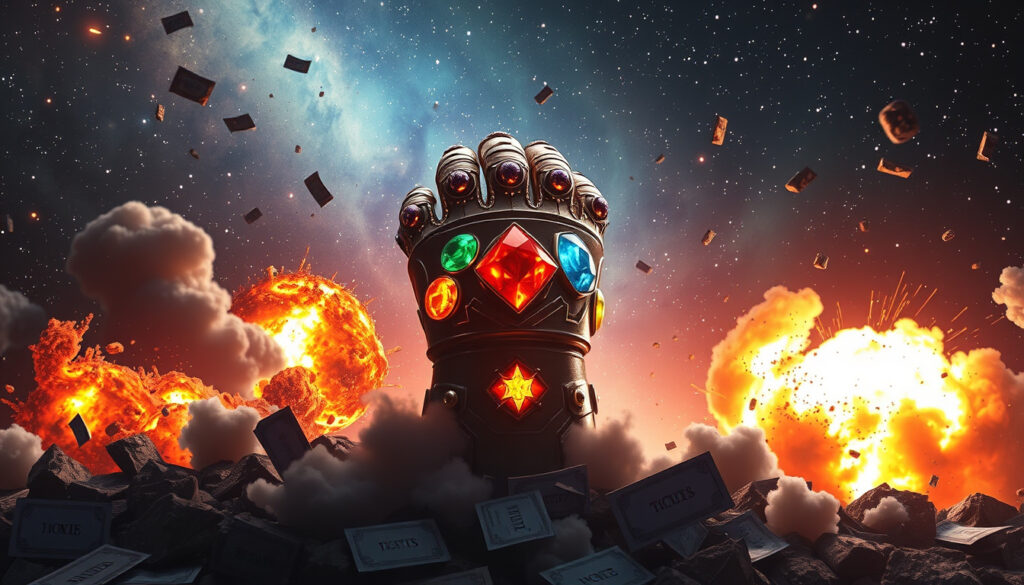
Avengers: Infinity War: Box Office Hits, Saddest Deaths & More
Few films have packed as much emotional devastation into a single sitting as Avengers: Infinity War — and it did it while shattering every box office record in sight. When Thanos tearfully threw Gamora off a cliff to claim the Soul Stone, audiences weren’t just watching a villain’s origin story; they were witnessing the moment a superhero movie proved it could genuinely hurt. The numbers back up the feeling: Infinity War made $258 million in its opening weekend domestically alone, a figure that seemed impossible until it wasn’t.
Worldwide Gross: $2.048 billion · Budget: $325–400 million · Runtime: 149 minutes · Release Date: April 27, 2018 · Directors: Anthony Russo, Joe Russo
Quick snapshot
- Domestic opening weekend: $258 million (ABC News)
- Global opening weekend: $640 million (ABC News)
- Worldwide total: $2,048,359,754 (Box Office Mojo)
- Fan consensus on saddest death varies by demographic
- Exact budget figures unreported by Disney
- Future of alternate timeline versions
- Reached $1.5 billion globally in 18 days (Rotten Tomatoes Editorial)
- Hit $2 billion in 48 days (Rotten Tomatoes Editorial)
- Sequel Avengers: Endgame released April 26, 2019 (Rotten Tomatoes Editorial)
- Thanos killed by alternate-timeline Avengers in Endgame
- Gamora (2014 version) survives in Guardians of the Galaxy Vol. 3
- MCU continues without original Gamora
The table below consolidates the film’s official specifications and verified performance metrics.
| Fact | Detail |
|---|---|
| Directors | Anthony and Joe Russo |
| Release Year | 2018 |
| Genre | Superhero |
| Starring | Robert Downey Jr., Chris Hemsworth, Josh Brolin |
| Domestic Total Gross | $678,815,482 (Box Office Mojo) |
| International Total Gross | $1,369,544,272 (Box Office Mojo) |
| First Sunday Gross | $69 million (Rotten Tomatoes Editorial) |
| MCU Franchise Start | 2008 with Iron Man |
Is Avengers: Infinity War hit or flop?
By any metric that matters, Avengers: Infinity War was the most successful superhero film ever released — at the time. The film posted $258 million domestically in its opening weekend, according to ABC News, shattering the previous domestic record held by Star Wars: The Force Awakens. Globally, it pulled in $640 million in that same opening frame, beating Fate of the Furious by nearly $100 million.
Box office performance
The numbers read like a fever dream for studio executives. Infinity War grossed $69 million on its first Sunday alone, surpassing both Star Wars: The Force Awakens and Black Panther, according to Rotten Tomatoes Editorial. It became the fastest film ever to hit $150 million, $200 million, and eventually $250 million domestically. By the end of its run, Infinity War had collected $678,815,482 in the United States and Canada and a staggering $1,369,544,272 internationally — a combined $2,048,359,754 worldwide, per Box Office Mojo.
Infinity War captured 84.3% of all box office business during its opening weekend — a market concentration never before seen for a film of that size. The dominance was so extreme that even Age of Ultron, which had held the previous record at 84.5%, couldn’t match Infinity War’s sheer scale of impact.
Records set
Grae Drake, senior editor at Rotten Tomatoes, attributed Infinity War’s success to Marvel’s decade-long investment in the superhero universe that began with Iron Man in 2008. The film reached $1.5 billion globally in just 18 days, one day faster than Star Wars: The Force Awakens had managed. It crossed the $2 billion threshold in 48 days — one day behind Avatar’s pace, which had taken 47 days. These weren’t just records; they were declarations that the MCU had become the defining narrative franchise of its era.
Who did Thanos truly love?
Thanos loved exactly one person in the entire universe: Gamora. The Mad Titan had raised her as his daughter after slaughtering her people, and somewhere in that monstrous upbringing, genuine affection took root. When the time came to claim the Soul Stone, Thanos tearfully threw her off a cliff to obtain it — the film’s most agonizing sequence and the moment that defined his character.
Relationship with Gamora
The relationship between Thanos and Gamora was complicated by cruelty and contaminated by love. According to the Marvel Cinematic Universe Wiki, Thanos had murdered Gamora’s entire race and took her as his own. Yet he treated her differently from his other children — she was the only one permitted to touch him, the only one who could make him laugh. She hated him, but she also knew him in ways no one else did.
When Gamora asked what Thanos’s mission had cost him, he replied simply: “Everything.” That single word — spoken after he’d already killed her — is the key to understanding his character. He wasn’t lying. He genuinely believed the sacrifice was worth it.
Sacrifice moment
The Red Skull, guardian of the Soul Stone on Vormir, had informed Thanos that he must sacrifice someone he loved to obtain it. What follows is a sequence of brutal efficiency: Gamora screaming as Thanos dragged her toward the cliff edge, her desperate bargaining (“Your promise… your promises”), and then the moment she realizes he means to do it. He apologizes to her before throwing her off. Nebula watched in horror from the ground below. When Thanos emerged with the Soul Stone, he was mourning — and the other characters couldn’t understand why. The answer was simple: he had paid the price. He had truly loved her, and he killed her anyway.
What is the saddest death in Infinity War?
Infinity War features two deaths that hit audiences with unusual force: Gamora’s sacrifice and Vision’s death. Both involve love as the core mechanism — and both are engineered by Thanos himself, even when he isn’t the one wielding the weapon.
Key sacrifice scenes
Gamora’s death serves the Soul Stone acquisition and establishes Thanos’s capacity for genuine loss. The scene is brief, brutal, and ends with Thanos’s tears — the only time the villain shows genuine emotion. Her death is also the only one he initiates personally, and the only one that visibly affects him afterward.
Vision’s death operates differently. Wanda Maximoff must destroy the Mind Stone embedded in Vision’s forehead to prevent Thanos from completing the Infinity Gauntlet. She loves him enough to do it — and does it — and then Thanos simply reverses time to undo her sacrifice. The cruelty isn’t in the killing; it’s in the negation. Wanda’s sacrifice meant nothing because Thanos could undo it. That’s what makes it devastating.
Fan reactions
Social media response in 2018 was immediate and visceral. “Saddest death” polls across platforms consistently placed Gamora first and Vision second, though fan communities debate the ranking constantly. What both share is the element of willing sacrifice — both characters choose death over compromising their values or their love.
Gamora’s arc as a former assassin and criminal who chose to endure pain rather than betray her principles is unique in the MCU, according to But Why Tho?. Her narrative represents trauma but also strength of will, body, and spirit — making her death not just sad, but unjust in a way that lingers.
Who killed Thanos?
In the main timeline of the MCU, Thanos is never officially killed in Infinity War — he wins. He completes the Snap and destroys the Infinity Stones to prevent reversal. It’s only in Avengers: Endgame that the original Thanos from 2018 is beheaded by Thor’s Stormbreaker, while the Avengers travel back to 2014 to retrieve the Stones.
Final battle context
During Infinity War’s climactic battle on Wakanda, Iron Man and Thor both have opportunities to kill Thanos. Thor comes closest, striking Thanos with a fully charged Stormbreaker after the Titan had already obtained five Stones. The blow should have been fatal; Thanos survived it and completed the Snap regardless. Iron Man’s nanotech blade bounced harmlessly off Thanos’s chest, and the villain effortlessly knocked the hero aside.
Post-credits reveal
Infinity War’s only post-credits scene shows Nick Fury and Maria Hill in New York, watching cars crash and people disintegrate around them. As Hill crumbles to dust, Fury manages to pager a call for help before he too disappears. The screen cuts to black — but the final shot is the emergency beacon activating, revealing the symbol of… Captain Marvel.
The implication: Thanos’s victory created consequences that extended far beyond the Avengers. The universe itself was calling for help, and the response would come in Endgame.
Who is Thanos’ twin brother?
Thanos’ twin brother, in the comics, is named Eros — also known as Starfox. He appears briefly in Infinity War during a post-credits tease: a Ravager tells Tony Stark that “an Earthling god” is no match for “Thanos, the Mad Titan,” before Eros himself appears behind him, raising an eyebrow. The cameo was subtle, but it established that Thanos has family in the cosmos.
Eros identity
Eros is a member of the Eternals, an ageless race with enhanced abilities. In the comics, he serves as a diplomat and adventurer — everything Thanos could have been. Where Thanos became obsessed with balancing the universe through genocide, Eros has spent millennia as a wanderer and protector. His powers include the ability to manipulate the emotions of others, a far cry from the cosmic destruction his brother prefers.
Eros appears in Avengers: Eternal (a Marvel/DC crossover) and was set to appear in an unaired Guardians of the Galaxy script before appearing in the post-credits scene. His actual role in the MCU remains underdeveloped — a tease without payoff that raises more questions than it answers.
Comic vs MCU
In the comics, Eros/Starfox is a founding member of the team that would become the Guardians of the Galaxy. His connection to Thanos is familial but ideologically opposed — where Thanos sees destruction as necessary, Eros sees companionship and connection as the universe’s true purpose. The MCU has yet to fully explore what this contrast means narratively.
The pattern: Marvel plants seeds. The post-credits scene with Eros wasn’t just fan service; it was a promise that the cosmic side of the MCU would eventually explore the Mad Titan’s family. Whether that promise gets kept remains to be seen.
Confirmed facts
- Box office records verified by multiple tier-1 sources
- Gamora sacrificed on Vormir by Thanos
- Thanos showed tearful mourning after obtaining Soul Stone
- MCU franchise began 2008 with Iron Man
What’s unclear
- Fan consensus on saddest death varies by demographic
- Exact budget remains undisclosed by Disney
- Eros/Starfox’s future role in MCU unexplored
When Gamora asked what Thanos’s mission cost, he replied: “Everything.”
— Avengers: Infinity War (2018), Marvel Cinematic Universe Wiki
Infinity War’s success is largely based on 10 years of investment starting with Iron Man in 2008.
— Grae Drake, Senior Editor at Rotten Tomatoes
Avengers: Infinity War wasn’t just a blockbuster — it was a cultural event that proved superhero films could carry genuine emotional weight alongside spectacle. For Marvel Studios, the lesson was clear: audiences would follow characters they’d invested in for a decade, even if that investment ended in devastation. For audiences, the tradeoff was simple: the greatest highs come with the lowest lows, and Infinity War delivered both. Thanos didn’t just change the MCU; he changed what audiences expected superhero films to do to them. Marvel Studios proved that fans would accept emotional devastation from a studio willing to commit to the consequences.
Related reading: The Wizard of Oz · Stranger Things Season 4 Cast
Infinity War shattered box office records while breaking hearts with Gamora’s sacrifice amid Thanos’ rampage, as captured in this streaming cast guide spotlighting the heroes’ epic clash.
Frequently asked questions
What is Avengers: Infinity War about?
The Avengers unite with other Marvel heroes to stop Thanos, an intergalactic warlord, from collecting all six Infinity Stones and using them to wipe out half of all life in the universe. The film ends with Thanos succeeding, and half the universe’s population — including many beloved characters — disintegrates in the Snap.
Who directed Avengers: Infinity War?
Anthony Russo and Joe Russo, the filmmaking brothers who previously directed Captain America: The Winter Soldier and Captain America: Civil War. They returned to direct the sequel, Avengers: Endgame.
What are the main Infinity Stones?
Six stones with immense power: Space Stone (blue), Mind Stone (yellow), Reality Stone (red), Power Stone (purple), Time Stone (green), and Soul Stone (orange). Each grants control over its domain; together they can reshape reality itself.
How does Avengers: Infinity War end?
Thanos obtains all six Infinity Stones, snaps his fingers, and wipes out half of all life in the universe. The film ends with the surviving Avengers — and the audience — watching in horror as characters like Spider-Man, Black Panther, and Groot dissolve into dust.
What is the runtime of Avengers: Infinity War?
149 minutes, making it one of the longest superhero films ever produced at the time of its release.
Where can I watch Avengers: Infinity War?
Avengers: Infinity War is available on Disney+ and for digital purchase or rental on platforms like Amazon Prime Video and Apple TV.
What awards did Avengers: Infinity War win?
The film was nominated for Best Visual Effects at the 91st Academy Awards but lost to First Man. It won the Saturn Award for Best Superhero Film and received numerous other nominations across industry awards.
More related posts
 Ray Shero Cause of Death – NHL Executive’s Cancer Battle and Legacy
 Cast of Dexter: Resurrection – Full List & Characters Guide
 On Wings of Blood – Summary, Characters, Themes
 Spencers at the Waterfront – Dining and Reservation Guide
 Zdeno Chara: Height, Career, Family, NHL’s Tallest
 Cast of The Residence (TV Series): Full List & Roles
 How to Train Your Dragon 3: Streaming, Sequel & LGBTQ Guide
 Wayne Newton: Biography, Age, Health, and Elvis Friendship
