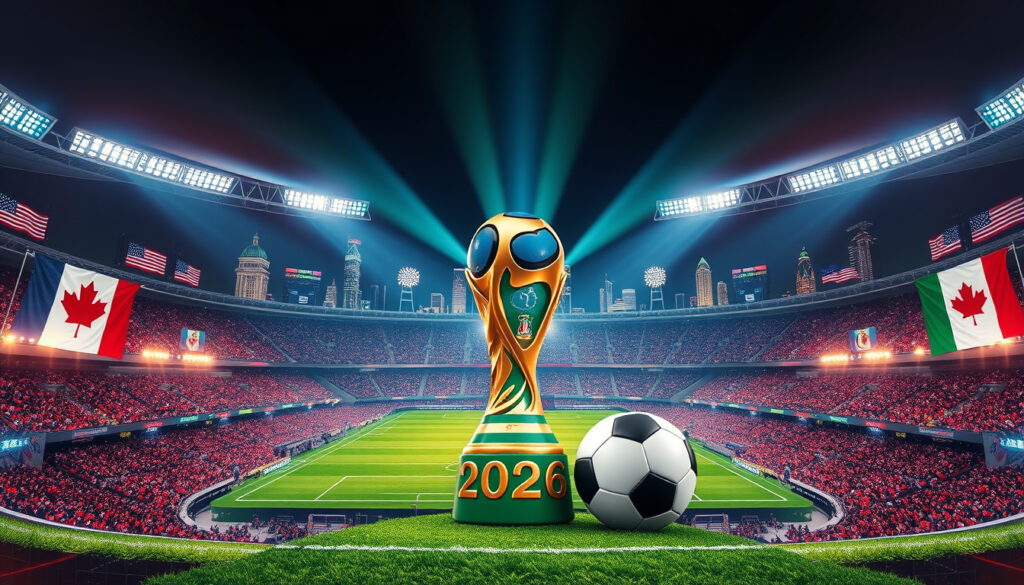
Coupe du Monde de Football 2026 – Everything You Need to Know
The 2026 FIFA World Cup represents a historic milestone in international football, marking the first tournament hosted jointly by three nations and the first to feature 48 competing teams since the format’s introduction. Scheduled to run from June 11 to July 19, 2026, the month-long competition will unfold across 16 cities in the United States, Canada, and Mexico, with the final match set to take place at MetLife Stadium in East Rutherford, New Jersey.
This expansion brings significant changes to the tournament’s structure, including a new group stage format and the most matches since 2002. The decision to stage the World Cup across three countries underscores growing interest in co-hosting major sporting events while providing fans across North America with unprecedented access to world-class football.
Where will the 2026 FIFA World Cup be held?
The 2026 FIFA World Cup spans three North American nations, with venues distributed across 16 host cities. The United States hosts the majority of matches, featuring 11 cities, while Mexico contributes three venues and Canada two. This tri-national arrangement marks a significant departure from traditional single-nation host models and reflects the scale required to accommodate 48 teams and 104 matches.
- First 48-team World Cup in modern era
- First tournament hosted jointly by three nations
- 104 total matches across 16 cities
- Record number of North American venues
- Semi-finals at AT&T Stadium (Dallas) and Mercedes-Benz Stadium (Atlanta)
- Opening match at Estadio Azteca, Mexico City (June 11)
- Final scheduled for July 19 at MetLife Stadium
| Fact | Detail |
|---|---|
| Host Nations | United States (11 venues), Canada (2), Mexico (3) |
| Tournament Dates | June 11 to July 19, 2026 |
| Matches | 104 total |
| Teams | 48 qualified |
United States Venues
American venues span the country from coast to coast, with stadiums concentrated in major metropolitan areas. The 11 U.S. host cities include Atlanta (Mercedes-Benz Stadium), Boston (Gillette Stadium), Dallas (AT&T Stadium), Houston (NRG Stadium), Kansas City (Arrowhead Stadium), Los Angeles (SoFi Stadium), Miami (Hard Rock Stadium), New York/New Jersey (MetLife Stadium), Philadelphia (Lincoln Financial Field), the San Francisco Bay Area (Levi’s Stadium), and Seattle (Lumen Field). Many of these facilities underwent renovations to meet FIFA standards, with typical capacities ranging from 65,000 to over 80,000 seats.
Mexico and Canada Venues
Mexico’s three host cities feature Guadalajara’s Estadio Akron, Mexico City’s historic Estadio Azteca with its capacity of 87,523, and Monterrey’s Estadio BBVA. Estadio Azteca holds particular significance as the venue for the opening match on June 11, continuing its legacy as a World Cup landmark. Canada’s contribution includes Toronto’s BMO Field and Vancouver’s BC Place, representing the first time Canada has hosted World Cup matches.
This marks the first World Cup in history to be hosted across three separate nations, establishing a precedent for future multi-country tournaments while showcasing North America’s capacity for large-scale international sporting events.
When is the 2026 World Cup schedule?
FIFA released the complete schedule on February 4, 2024, confirming that the tournament begins on June 11, 2026, with Mexico facing South Africa at Estadio Azteca in Mexico City at 1 p.m. EST. The group stage extends over approximately two weeks, with matches distributed across all 16 venues before the knockout rounds commence.
Group Stage Highlights
The opening day features multiple fixtures, including South Korea versus UEFA Winner D at Estadio Akron in Guadalajara. Subsequent days bring high-profile matchups such as USA versus Paraguay at SoFi Stadium in Los Angeles on June 12, and Haiti against Scotland at Gillette Stadium in Boston on June 13. MetLife Stadium in New York/New Jersey hosts Brazil versus Morocco on June 13, highlighting the venue’s prominence throughout the tournament.
Key group stage encounters span diverse matchups including Saudi Arabia versus Uruguay at Hard Rock Stadium in Miami on June 15, and Mexico against South Korea at Estadio Akron on June 18. The group stage concludes with matches such as Ecuador versus Germany at MetLife Stadium on June 25. For detailed scheduling information, fans can consult official tournament schedules.
Knockout Phase Timeline
Following the group stage, the Round of 16 begins in late June, followed by quarter-finals in early July. The semi-finals are scheduled for AT&T Stadium in Dallas and Mercedes-Benz Stadium in Atlanta. The tournament culminates with the final on July 19 at MetLife Stadium, concluding a 39-day competition that represents the longest World Cup in modern history.
Matches are scheduled in Eastern Standard Time unless otherwise noted. With venues spanning multiple time zones from the Pacific Coast to the Eastern Seaboard, fans attending games in different cities should account for time differences when planning travel between host cities.
What is the format of the 2026 FIFA World Cup?
The 2026 World Cup introduces a restructured format accommodating 48 teams, a significant increase from the 32-team structure used since 1998. The expanded tournament replaces the previous format of 16 groups containing 3 teams each with 12 groups of 4 teams. This adjustment allows for more competitive matches while reducing the risk of collusive results that occasionally plagued smaller group configurations.
Group Stage Structure
Each group features four teams playing round-robin matches, with the top two finishers from each group advancing to the Round of 16. This format produces 48 group stage matches, with teams guaranteed at least three matches during the tournament compared to the previous minimum of three. The FIFA Council approved this structure, and confederation qualification spots have been allocated accordingly.
Tournament Statistics
The 48-team format generates 104 total matches, the most since the 2002 World Cup in Japan and South Korea. This increase reflects both the additional group stage matches and the expanded knockout bracket. The format balances competitive integrity with manageable tournament duration, though critics note that the extended schedule places greater physical demands on players and requires more extensive infrastructure from host nations.
| Stage | Matches | Teams Advancing |
|---|---|---|
| Group Stage | 48 | 24 |
| Round of 16 | 16 | 16 → 8 |
| Quarter-finals | 8 | 8 → 4 |
| Semi-finals | 4 | 4 → 2 |
| Final | 1 | Champion |
Which teams have qualified for the 2026 World Cup?
As host nations, Canada, Mexico, and the United States automatically qualify for the tournament without participating in qualification matches. This automatic qualification applies to all three co-hosts, ensuring their presence at the expanded event regardless of their standing in FIFA rankings or recent competitive results.
Confirmed and Projected Participants
Many major footballing nations have already secured their places through confederation qualification processes. Brazil, a five-time champion, appears confirmed via tournament draws, along with European powers England, France, Germany, and Spain. The Netherlands and other established football nations are similarly positioned. Remaining qualification spots depend on ongoing continental qualifying campaigns across UEFA, AFC, CAF, CONMEBOL, and OFC regions.
Intercontinental playoffs will determine several remaining spots, with winners advancing to complete the 48-team field. The official FIFA World Cup portal provides current qualification updates and bracket information as processes conclude.
Group Stage Matchups
Several group stage fixtures have been established through qualification and draw processes. Group A features Mexico versus South Africa on June 11 at Estadio Azteca, along with South Korea facing UEFA Winner D. Group B includes Canada’s opening match against UEFA Winner A at BMO Field on June 12. Group C showcases Brazil against Morocco at MetLife Stadium on June 13, while Group D features the United States versus Paraguay at SoFi Stadium on June 12.
Several qualification spots and specific group assignments remain unconfirmed as continental qualifying tournaments continue. Fans should verify current qualification status through official FIFA channels before making travel arrangements.
Key moments in the road to 2026
The journey toward the 2026 World Cup began years before the tournament’s scheduling announcement, with bid processes, venue selection, and qualification campaigns shaping the event’s development. Understanding the timeline provides context for the scale of organizing such a major international competition.
- June 2018 – USA, Mexico, and Canada win the joint bid to host the 2026 World Cup
- 2023–2025 – Continental qualification campaigns ongoing across six confederations
- February 4, 2024 – Full tournament schedule officially released by FIFA
- December 2025 – Final draw determines group stage matchups and bracket positions
- June 11, 2026 – Opening match at Estadio Azteca, Mexico City
- July 19, 2026 – Final at MetLife Stadium, East Rutherford, New Jersey
What is confirmed versus what remains unclear?
While substantial information about the 2026 World Cup is publicly available, certain aspects remain subject to change as qualification processes continue and operational planning develops. Distinguishing confirmed details from pending announcements helps readers understand the current state of tournament preparation.
| Confirmed | Still Being Determined |
|---|---|
| Host nations (USA, Canada, Mexico) | Complete qualified team list |
| Tournament dates (June 11 – July 19, 2026) | Specific kickoff times for all matches |
| 48-team format with 12 groups of 4 | Some group stage assignments |
| 16 host cities and venues | Detailed ticket pricing tiers |
| Opening match venue and date | Fan zone locations and capacities |
| Final venue and date | Broadcast coverage details beyond FOX Sports |
Why does this World Cup matter?
The 2026 World Cup represents several significant milestones for international football governance and tournament organization. The expansion to 48 teams increases participation opportunities for nations historically underrepresented at the sport’s premier competition, potentially reshaping the global football landscape over subsequent tournaments. The tri-national hosting arrangement demonstrates new approaches to managing resource-intensive events while spreading economic and cultural benefits across multiple markets.
From a North American perspective, hosting the World Cup provides infrastructure investment, tourism opportunities, and national engagement with global football culture. The tournament’s scale—requiring 16 stadiums across three countries—represents an organizational challenge that may inform future multi-host events. As noted by tournament organizers, the event aims to deliver memorable experiences while establishing sustainable legacies for host communities.
The U.S. Soccer Federation and its counterparts in Canada and Mexico have emphasized their commitment to sustainability and community impact, though specific legacy programs continue developing as the tournament approaches. Broadcast agreements with FOX Sports ensure comprehensive coverage across the United States, with international broadcast arrangements varying by region.
Sources and official information
“The 2026 FIFA World Cup will be the most expansive and inclusive edition in our sport’s history.”
— FIFA President
Primary sources for World Cup information include official FIFA communications, national football governing bodies, and authorized ticket sales platforms. FIFA’s dedicated tournament portal provides the most authoritative updates on scheduling, qualification, and organizational matters. Additional context comes from Britannica’s tournament coverage and venue-specific resources.
Ticket registration and interest forms are available through FIFA’s official channels, requiring creation of a FIFA ID for access to ticket sales platforms. Canadian qualification updates appear on the Canada Soccer Association website, while Mexican coverage is accessible through dedicated tournament resources.
What to watch for next
The period leading to June 2026 will bring continued qualification action, final draw procedures, and operational preparations across all 16 host cities. Fans should monitor official FIFA announcements for schedule confirmations, ticket sale dates, and travel guidance. The expansion of participating teams means more nations than ever will experience World Cup football, creating new narratives and rivalries as the tournament approaches.
For those planning attendance, early preparation regarding match scheduling, venue locations, and travel logistics between host cities will prove essential given the geographic spread of venues. Accommodation in host cities, particularly New York/New Jersey for the final, will likely see significant demand as the tournament date approaches.
Related coverage includes analysis of FC Barcelona vs Borussia Dortmund Stats and broader Olympic scheduling information such as Calendrier et Résultats Hockey sur Glace aux Jeux Olympiques 2026 for those interested in other major sporting events.
Frequently asked questions
How many matches will be played at the 2026 World Cup?
The 2026 World Cup will feature 104 total matches, the most since 2002. This includes 48 group stage matches, 16 Round of 16 matches, 8 quarter-finals, 4 semi-finals, and the final.
Which countries won the bid to host the 2026 World Cup?
The United States, Canada, and Mexico jointly won the hosting rights in June 2018. This marks the first World Cup hosted by three nations and the first held in North America since 1994.
How does the group stage format work?
The tournament uses 12 groups of 4 teams each. Each team plays three group stage matches. The top two teams from each group advance to the Round of 16, creating a 24-team knockout bracket.
When and where is the 2026 World Cup final?
The final is scheduled for July 19, 2026, at MetLife Stadium in East Rutherford, New Jersey. The stadium, opened in 2010, will be rebranded as New York New Jersey Stadium for the tournament.
Which teams automatically qualify for the 2026 World Cup?
The three host nations—Canada, Mexico, and the United States—automatically qualify. No qualification matches are required for these teams.
Where can I buy tickets for the 2026 World Cup?
Tickets will be sold through FIFA’s official platform. Prospective buyers should register interest via FIFA.com/tickets and create a FIFA ID. Official sales phases and pricing will be announced through FIFA’s channels.
How many venues are in the United States?
The United States hosts matches in 11 cities: Atlanta, Boston, Dallas, Houston, Kansas City, Los Angeles, Miami, New York/New Jersey, Philadelphia, San Francisco Bay Area, and Seattle.
More related posts
 Nick Tarnasky: From NHL Enforcer to Viral Golf Fight and Coaching
 Pâte à Pizza Maison: Tips for Perfect Homemade Pizza Dough
 Lana Condor Biography: Age, Ethnicity, Movies, and Family
 Dhar Mann: Biography, Controversies, Actor Tribute, and Net Worth
 Trisha Paytas: Net Worth, Kids, Husband, Mental Health, and Career
 Sean Astin Bio: Biological Father, Net Worth, Famous Roles
 1 Bitcoin to USD: Live Price, Pizza Day & Returns
 0 Interest Car Deals Ireland 2026: Get Zero APR Financing
