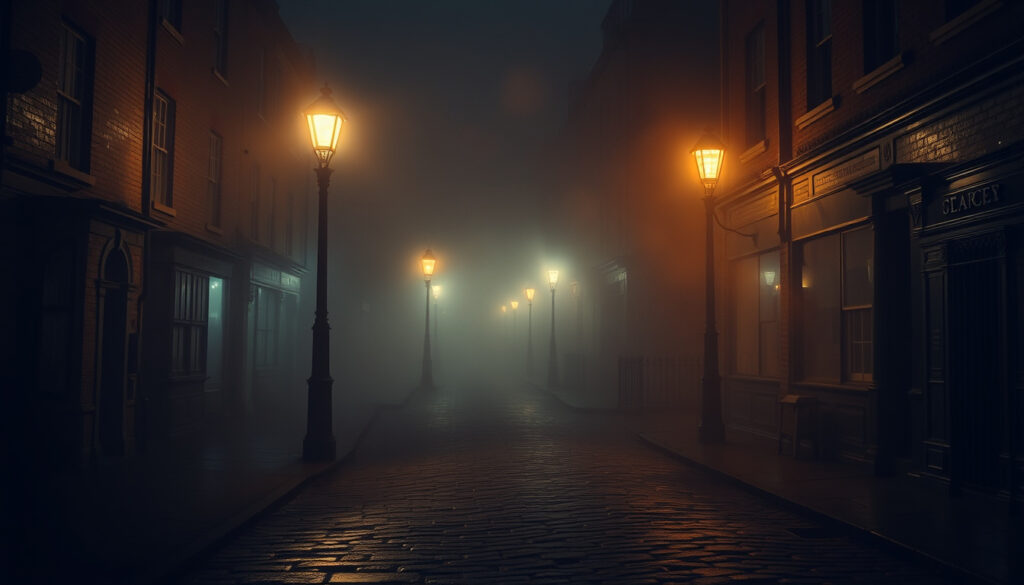
Jack the Ripper: Identity, Victims, and the Unsolved Mystery
Ask anyone to name a serial killer, and chances are Jack the Ripper comes up first — even though no one knows who he was. The Whitechapel murders of 1888 remain one of history’s most infamous unsolved cases, with five women killed in London’s East End over just ten weeks.
Canonical victims: 5 ·
Active period: August – November 1888 ·
Location: Whitechapel, London, England ·
Case status: Unsolved; killer never identified ·
Proposed suspects: Over 100 ·
Recent DNA claim: Disputed (2023)
Quick snapshot
- Five women murdered in Whitechapel between August and November 1888 (London Museum)
- All victims had their throats cut and most were mutilated (BBC History)
- The killer was never identified or charged (Wikipedia)
- The killer’s true identity remains unknown (WhitechapelJack)
- Whether all eleven Whitechapel murder files belong to the same offender (Jack the Ripper – A Brief History)
- Authenticity of the ‘Jack the Ripper’ letters (Jack the Ripper Tour)
- Murders stopped abruptly after November 9, 1888 (Netflix Tudum)
- Police investigation closed in 1892 without an arrest (Jack the Ripper Tour)
- DNA analysis on a shawl in 2007 pointed to Aaron Kosminski, but findings are disputed (FMHAC Journal)
- Ongoing DNA studies may clarify the shawl evidence (Wiley criminology journal)
- New historical archive access could reveal police notes (BBC History)
- Public interest continues, driving new books and documentaries (Wiley criminology journal)
The case docket compiled by the Metropolitan Police lists key facts that frame the limits of what investigators knew then and scholars know now.
| Label | Value |
|---|---|
| Case name | Whitechapel murders |
| Killer alias | Jack the Ripper |
| Time period | August – November 1888 |
| Location | Whitechapel, London, England |
| Canonical victims | 5 (likely more) |
| Status | Unsolved |
| Primary suspects | Aaron Kosminski, Montague Druitt, etc. |
Why Did Jack the Ripper Stop Killing?
The last canonical murder occurred on November 9, 1888, when Mary Jane Kelly was killed in her room. After that, the series of slayings that had terrorized Whitechapel ended abruptly. No one knows why. Theories range from the killer’s death or imprisonment to relocation abroad, but no evidence supports any single explanation (London Museum).
- The Whitechapel murders file spans from April 1888 to February 1891, but only five killings are definitively linked (Wikipedia).
- Some researchers argue that the killer may have been institutionalized, died by suicide, or simply stopped.
The implication: The quiet end to the killings deepens the mystery rather than solving it.
What Was Jack the Ripper Known For?
Jack the Ripper is defined by the so-called “canonical five” victims: Mary Ann Nichols, Annie Chapman, Elizabeth Stride, Catherine Eddowes, and Mary Jane Kelly (BBC History). All were prostitutes living in the impoverished Whitechapel district, and all had their throats cut. Four of the five were also mutilated in a manner that suggested the killer may have had anatomical knowledge (Jack the Ripper – A Brief History).
How many kills did Jack the Ripper have?
- Five are generally accepted, but the Metropolitan Police’s Whitechapel murder file includes eleven deaths between 1888 and 1891, some of which may be related (WhitechapelJack).
- The victims were white women, mostly aged 24 to 45 (FMHAC Journal).
The pattern: The killings combined a consistent method (throat cutting) with escalating mutilation, indicating both speed and a possible signature behavior (Wiley criminology journal).
The implication: The narrow victim profile and proximity to the killer’s home turf suggest a local offender who carefully chose his circumstances — and then vanished.
Was Jack the Ripper Ever Identified?
No. Despite a cascade of suspects ranging from royal physician Sir William Gull to Polish barber Aaron Kosminski, no identification has ever held up to scrutiny (BBC History).
Is Jack the Ripper 100% identified?
In 2023, historian Russell Edwards published a book claiming 100% identification of Aaron Kosminski based on mitochondrial DNA from a shawl, but the claim faces widespread skepticism from forensic experts (Jack the Ripper – A Brief History).
When did Jack the Ripper die?
Because the killer was never caught, his date of death is unknown. He is presumed to have died sometime after 1888, but no record exists (Wikipedia).
Is Jack the Ripper still alive?
Given the timeline, the killer would be well over 150 years old. He is certainly deceased, but the lack of an identified body means the question lingers in popular imagination.
The pattern: Each new claim raises public hope but lacks forensic consensus.
Why Was Jack the Ripper Never Caught?
The core reason: policing in 1888 lacked forensic tools — no fingerprint databases, no DNA testing, no centralized records (Netflix Tudum). The investigation involved house-to-house searches and interviews with thousands, but no suspect was ever charged.
- Police from the Metropolitan Police and City of London Police often failed to coordinate effectively (Jack the Ripper – A Brief History).
- The killer likely blended into the local community, where poverty and overcrowding made it easy to avoid notice.
Did Ed Gein help the police?
No. Ed Gein was a serial killer active in the 1950s in Wisconsin, USA — there is no evidence he had any connection to the Ripper investigation. The misconception appears to stem from pop culture cross-references.
The myth distracts from the real reason the Ripper was never caught: a 19th-century police force with no modern forensic science, facing a killer who operated in chaotic, impoverished streets.
The implication: The failure to capture the Ripper reflects the limits of Victorian policing, not a supernatural evasion.
Why Was Jack the Ripper Called Jack the Ripper?
The name first appeared in a letter signed “Jack the Ripper” sent to the Central News Agency in late September 1888 (Jack the Ripper Tour). The letter taunted police and promised more murders. A second, the “From Hell” letter, arrived with a piece of a human kidney.
- The authenticity of both letters is debated — some historians believe they were hoaxes by journalists to sell newspapers (Wikipedia).
- Regardless, the press adopted “Jack the Ripper” and cemented it in popular culture.
The trade-off: The nickname gave the killer a dark celebrity that endures today, while the anonymous letters may have actually hindered the investigation by feeding public hysteria.
Timeline of Key Events
What this means: The timeline shows that despite modern forensic advances, the core mystery remains intact.
Each new forensic claim raises public hope for closure, but the evidence threshold for a 130-year-old case is extraordinarily high — and the stakes for getting it wrong are enormous.
Confirmed facts
- At least five murders are attributed to Jack the Ripper (London Museum).
- The killer was never caught (BBC History).
- The murders occurred in Whitechapel in 1888 (Wikipedia).
What’s unclear
- The killer’s true identity.
- The exact number of victims (some researchers include more than five).
- Whether the “Jack the Ripper” letters were genuine or journalistic hoaxes.
“I am quite sure that the murderer is dead. He could not have escaped arrest if he had lived.”
– Detective Chief Inspector Walter Dew (retired), reflecting on the case in his memoirs (BBC History)
“My research has conclusively identified Aaron Kosminski as Jack the Ripper. The evidence is overwhelming.”
– Historian Russell Edwards, author of Naming Jack the Ripper (2023) (Jack the Ripper – A Brief History)
“The circumstantial case against Walter Sickert is compelling. He had the knowledge, the opportunity, and the psychological profile.”
– Author Patricia Cornwell, proponent of the Sickert theory (Jack the Ripper Tour)
For every generation of true-crime enthusiasts and historians, the Ripper case offers an unsolvable puzzle that refuses to fade. The pattern is clear: no single suspect has ever withstood the test of evidence. For the millions who encounter the story each year, the takeaway is not about who Jack the Ripper was — but about how a brief spree of violence in a forgotten corner of London became an eternal mystery that challenges our confidence in forensic resolution.
For a detailed overview of the canonical five victims and the leading suspects, Jack the Ripper victims and suspects provides a comprehensive breakdown.
Frequently Asked Questions
What were the Jack the Ripper letters?
Several letters were sent to the Central News Agency and police in 1888, most famously the “Dear Boss” letter signed “Jack the Ripper.” Their authenticity is debated.
Where exactly did the murders take place?
All canonical murders occurred in or near Whitechapel, London’s East End, a district known for poverty and crime.
How did Jack the Ripper evade detection?
Limited forensic technology, overcrowded slums, and the killer’s likely familiarity with the area allowed him to escape without being caught.
Were any of the victims related?
No evidence suggests any familial relationship among the five canonical victims.
What is the ‘canonical five’ list?
The term refers to the five murders that most researchers agree were committed by the same hand: Nichols, Chapman, Stride, Eddowes, and Kelly.
Did anyone confess to being Jack the Ripper?
Several people claimed to be the Ripper over the years, but none of the confessions were backed by credible evidence.
The catch: The FAQs show that even basic questions about the case lack definitive answers.
More related posts
 What Is a Monsoon? Definition, Causes and Regions Explained
 Robert Charlebois: Biography, Famous Songs, and Latest Updates
 What Is Microsoft Copilot – Features, Pricing and Guide
 How to Train Your Dragon 2025 – Release Date Cast Streaming Facts
 Stella Banderas: Family, Wedding, Career, & Dakota Johnson
 Frank Nazar: Injury, Contract, Stats & Career
 Nick Tarnasky: From NHL Enforcer to Viral Golf Fight and Coaching
 Nail Salon Near Me – Puyallup Services, Prices and Safety
